AddThis script

Monday, June 22, 2015

Grief and Defining Moments

defining moments
Introducing Six Hens
During the last few months, grief has edged ever-so-slightly from the center to make space for creativity. It is with great honor that I introduce Six Hens, a literary magazine featuring true stories about life's defining moments. They are moments that color events in our lives, breathe life into projects, make us shift, shape, and remember. They define us; they redefine us. They are bitter, sweet, and flavor the spectrum in-between. They create the outlines that we step into. They provide the lily pads from which we leap. This magazine is me leaping...Welcome to Six Hens.

Suzanne Galante, Editor in Chief

Tuesday, June 09, 2015

Grief and blank spaces

grief and birthdays
The "H" Word
Saggy balloons hang from the wall outside my bedroom door. They are attached to a handmade sign declaring that thing you’re supposed to say to people on the anniversary of their birth that includes the “H” word. It was my husband’s birthday last Thursday and with great enthusiasm the children scurried around the house before they went to school that morning. They put gifts in bags and stuffed colorful tissue paper on top. They blew up balloons, made that sign, and taped those things carefully to the wall as they wondered what kind of cake we might eat later that day. I didn’t tell them that there wouldn’t be any cake.

But I was wrong. Last Thursday was also the final night of our family grief group, and at the end of the evening, there was a box of cookies, a plate of deviled eggs, and a cake. They were thrilled. Different activities beforehand made us end up with two cars there. The kids all piled into my husband’s Jeep and I drove home solo with Talyor Swift’s addictive love songs keeping me company. I was spared the children’s singing, the laughing, the merriment.

It was after their regular bedtime when we got home. Yet, the presents hadn’t been opened. As we sat on the ground near the sign, the kids presented each gift and Husband received it with fanfare. “We sang Happy Birthday all the way home!” they said. From there, they burst into several variations of the song, substituting silly words for the regular ones, making them fall all over each other with delight. Colorful bags and a rainbow of tissue paper covered the beige carpet. “How is this a happy day?” I wanted to shout at them, to temper their enthusiasm and jubilance. “Riley isn’t here. No days are happy days.”

But they are children and they don’t know about grown-up feelings. They lost their brother, they don’t want to lose Christmas and birthdays, too. I kept inching myself away from their sounds. I wanted it to stop. This line of being with the living and staying with Grief is a balance I haven’t figured out. I could feel Grief’s open arms waiting for me a few feet behind in the comforts of bed. It loves me, comforts me, feels safe. The feelings are mutual.

Husband shuffled the kids off to bed and I plowed my face into pillows and refused to speak. I transformed from Present Buying Wife into Bitch Wife, angry that Husband had a birthday in the first place. Angry that his family sent birthday cards. Angry that he called them and laughed and joked about who-knows-what. I could still picture him jumping around the kitchen like one of the kids repeating, “It’s my birthday. It’s my birthday.” In between each line, I hear: Riley died. Riley died. Riley died. Riley died. Riley died. Riley died. That’s what I always hear in the blank spaces.

I tried to explain the other day what the world is like to me. It goes something like this:

Husband: “Do we need milk?”

Wife: Riley died. Riley died. Riley died. “I’ll look.” Riley died. Riley died. Riley died. “Yes, soy milk and regular milk.” Riley died. Riley died. Riley died.

Husband: “Ok, I can stop at Trader Joe's after I get the kids from the Youth Center.”

Wife: Riley died. Riley died. Riley died. “Ok, will you also pick up some fruit for lunches? And cream cheese, too?” Riley died. Riley died. Riley died. Riley died. Riley died. Riley died.

Husband: “Absolutely.”

Wife: Riley died. Riley died. Riley died. Riley died. Riley died. Riley died. Riley died. Riley died. Riley died. Riley died. Riley died. Riley died. Riley died. Riley died. Riley died…

With my head pressed into the pillow and the blanket over my head, I refused to acknowledge the birthday boy for the rest of the night. I couldn’t look at the 44-year-old version of my husband. I don’t know him. My 43-year-year old husband cleans Riley’s glasses and gets Riley to roll his eyes. He carries Riley to the treehouse when it’s too hard for Riley to schlep up the hill for the kids' overnight in the yard. He reads the latest Rick Riordan to him as he lies in the hospital bed. He tussles his blond hair before burying his face into the unkempt locks to deliver a kiss. This 44-year-old husband won’t do those things.

The lights go off and Husband climbs into bed beside me, scoops me into his arms anyway. I don’t resist, but I don’t sink into him either. Once I feel him drift into sleep, I get out of bed and wrap my housecoat around my sad body. With flashlights, I fumble behind the house looking for the dull ax. From there, I begin whacking what used to be the “Gratitude Tree” in my front yard. “I hate you Gratitude Tree.” Whack. “Why did you have to die?” Whack. “I’m so sorry.” Whack. “Don’t be mad because I’m chopping down this tree.” Whack. “Please forgive me.” Whack. “Fall you fucking tree.” Whack. For nearly an hour I hack at it.

When it’s finally severed, I sat in my sweat-soaked robe on the brick wall and watched the full moon rise over the neighbors’ houses. From there, I crawled back into bed; I was finally able to sink into my husband, let him hold me, comfort me. I looked forward to admiring my handiwork in the days to come. But the next day, the gardeners removed the tree’s trunk and downed branches as well as the stump. Where it used to stand is just a clean, blank spot in the lawn covered with stones. Three days later, my right forearm and elbow swollen to almost double the size of my left arm, I wonder if it was worth it.

Monday, May 11, 2015

Grief and lies

When my kids were small, we would walk hand in hand to school. I’d be sandwiched between two blond boys with a pair of velcroed shoes on my left and laced ones to my right. Riley would try to roll the skin between my thumb and first finger. We’d sing catchy tunes from the radio and skip and talk about what playdates we’d have and when and what we’d have for dinner that night and whether grandma was going to be watching them because I had class.

grief bereaved mom
Notes from classmates
I’d walk them through their elementary school’s corridors right up to their classrooms and watch as they unpacked their lunch boxes and hung their backpacks on their hooks on the walls decorated with butterflies and ladybugs. They’d send me off with tight hugs and professions of love. Sweet, sweet boys. “You’re meeting me at the flagpole after school, right?” The answer was always yes. Then they’d scurry into their rooms and find their assigned seats.

I was often at school. Over the years, I’ve been a volunteer art teacher and a volunteer gardening teacher. Every Wednesday for two years, I read in C’s classroom. I talked to 4th graders about the books they’d been reading, helped with classroom parties, made grand trays of caprese salad for the end-of-year picnics and attended music concerts and plays and dined in the Scat Cat Cafe hosted in Riley’s 2nd grade classroom.

Since October, I’ve been to the elementary school three times--once on the morning when C resumed 3rd grade after Riley died, once for his parent-teacher conference, and once for his glee concert last Friday. For the concert, I stood in the rear corner and sobbed. Between songs, I stepped through the open door to get fresh tissues and breathe the outside air deeply, trying to settle myself. I avoided other parents and bolted for home after the applause faded and C said goodbye to his buddies.

C takes himself to and from school on his scooter these days. But per his request, I’ve recently started meeting him halfway down our street. At 2:30, I wander toward school and he races toward home and we meet somewhere in the middle, usually just around the bend from the house with the metal dragon sculpture in the front garden. C is usually the only person I talk to on those journeys, just the way I like it.

But last week, my neighbor was tending some shrub or other as we passed. I flinched as he looked toward us. “How’s it going?” he asked. “Hanging in there,” I lied, after a slight pause. I stole that line from my other neighbor who recently lost her husband. It’s a non-answer, really, and it's probably the first time I've answered that question without using the words terrible, heartbroken, or not so good. Those responses seem to stump people, and I didn't have the energy to engage with him about my reality. The one where I want to do nothing but sleep because when I'm sleeping, I don't know that Riley is dead. And let's be honest, most people don't actually want to know how I'm doing.

How I long to go back in time and walk those boys to school again. The uncertainty of Riley's health was always the undercurrent in my daily life, but that uncertainty was far more palatable than this reality.

Monday, April 20, 2015

Grief and fighting

The soles of my hiking shoes crunched along the composite as I sauntered down the long, empty trail taking me from here to there. Inching along with the fog hovering over my shoulder like an enthusiastic editor, I willed someone to come out from behind the tangled poison oak and manzanita to mess with me.

Green worry stone
Nothing scares me. Not that I was anywhere scary. Pulgas Ridge is a county open space preserve sandwiched between sleepy San Carlos and Redwood City. Years ago, it was home to a tuberculosis sanitarium and skeletal remains in the shape of cement stairs are interspersed among the trails and fields of oak. I’ve been hiking there on my own since Riley was a newborn strapped to my torso in a baby carrier 12 years ago. The scariest encounters would include a fistful of teenaged boys wandering into the dusky acres to get stoned and an older man donning a hat and sunglasses that set of my dog’s attack instinct. And neither of those were actually scary. Still, I couldn’t help but hope for a fight. I pictured this faceless stranger and readied my response: “Yeah, you want to mess with me today? You might want to rethink that because I’ll claw you open.”

Today, you see, is the 6-month anniversary of my son Riley’s death. I rubbed a green glass stone between my fingers as my legs took me along the trail. I couldn’t feel them and was amazed that I managed to stay vertical. They are numb so much of the time. I have to think about my arms, too, and will them to grasp and shift and lift and brush. The only part of my body that I feel is my heart. It beats with mind-boggling regularity. The simplicity of it--unconscious, reliable, unfailing--yet something his heart could do no more. When I’m still, I feel the muscle thumping against my ribcage. Then I remember those hours as his heart slowed, slowed…… slowed…………. slowed…………………... until it squeezed for the last time. Afterward, I crawled onto the bed beside him and held his still body. Then I left him there, alone, and got into my car and went home without him.

The muscular golden dog trotted up beside us as we walked the hill to where I visit the stone memorial I made for Riley. It looked like the Rhodesian Ridgeback with the same name I met a few weeks after Riley died. How fitting, I thought to see that dog again on this sad anniversary. I hadn’t seen him since November when I couldn’t bear to speak that horrible truth to his owner.

“Haven’t seen you in a while, Riley,” I said to the dog as he followed my girl Pepper as she leaped after her tennis ball. Then coming down the hill was the dog’s owner and a friend. As they approached me, I said, “Is that Riley?” just wanting to make sure it was the dog I thought it was. The man said yes. “Do you spell it like this?” I asked as I pointed to the black grief band I wear with RILEY embroidered in kelly green. He said yes. “Is that your dog’s name, too?” his friend asked. “No, it was my son’s name. He died six months ago today,” I said.

Their faces twisted with compassion as the emotion dripped down my cheeks. “That’s got to be the most difficult kind of hard,” the friend said. “Are you getting some support from a counselor?” I am. “I have a lot of support; I’m really lucky that way. But I can’t say it makes it any easier,” I said. “I can’t imagine it does,” he replied. We talked about the dogs for a bit and I pet this furry Riley before continuing up the hill.

I am so profoundly sad and heartbroken and it is still so very impossible for me to believe that he has died. With two houses, it just seems like he must be at his dad’s house. And then there are all the days when C is with me and Riley is not there and that idea that he is just at his dad's house becomes even more impossible.

I miss the simple things...his crazy soft hair, the way he bites his cuticles, how he couldn't hear me ask him a question when he was reading, the way he said "mom." I miss the way he held his Freddies--his beloved penguins--one in each arm at bedtime.

Impossible for people who have not lost a child to understand what it feels like, imagine a gaping, constant loss. Every time you see one of your children--every time you eat together or go somewhere in the car, someone is missing. Every time you talk to one or your children or think of them. Every time you wash their laundry or pick up one of their books or shoes, or every time you imagine tomorrow or the weekend or summer vacation--delete them from each of those images. When you grocery shop, you don't need to buy their favorite cereal. When you go to a child's baseball game, or school event, or see one of their friends, it is a reminder that they are gone from this world. Every night when you kiss them at bedtime, they are not there. It's like losing Riley hundreds of times each day.

Imagine never having another photo of your child. There will be no more photos of Riley. There will be no more pictures drawn. The few precious times I’ve happened upon a scrap piece of paper that he doodled on, it instantly became a sacred item placed on the desk in his bedroom because there will be no more doodles.

No, there were no leery individuals on my hike at Pulgas Ridge. There were no fights for me to funnel my anger into. It was just me and my own internal battle, a wild spectrum with weapons crafted of rage and sadness, loss and disbelief, pain and numbness. It would have been his 12th birthday on April 2.

Wednesday, March 25, 2015

Grief and another death

Like getting ready for a date, I drew black lines over my eyelids, dabbed mascara to darken my fair lashes, and pressed a few curls into my hair. I slipped my feet into black heels. Gray slacks encircled my legs and a black blouse hung around my torso. As I assessed this dressed-up version of myself in the full-length mirror near my closet, I didn’t recognize my reflection. “You can do this,” I said to the woman starting back at me. She didn’t reply, only looked at me with her sad eyes and sad face and solemn outfit.

Heart made by his daughter
The act of getting dressed and styled had nothing to do with a date. Our family was headed to the memorial for our neighbor—a husband and father with two young children. I didn’t really know him, but we saw him every day as he walked his daughter down the hill to school with his young son and family dog in tow. Holding hands, looking at leaves in the gutter, and admiring stones and bugs, they were a part of our morning routine as we looped back from dropping our big kids at middle school. That simple act of walking with his children will be the image I hold of him; it’s a lovely image. He had a gentle, loving presence and a gentle, patient voice.

“I wish I’d taken some Vitamin A,” I’d said to my husband as my heels clinked along the sidewalk, referring to the anti-anxiety medicine I’d been prescribed before Riley went into the hospital. “Do you have it with you?” he’d asked in reply as he extended his arm for me to clutch. I didn’t, and my body was rigid with the emotions of my son’s death and of walking into his memorial only a few months ago. Another untimely death. More grieving children and families.

Where Riley, father, and family cat live now
This Death seems to have paid no attention to years. This Death has given little consideration for the young people left behind who grow up without their brother or their father. This Death couldn’t care less for the bereaved mother (vilomah) or the bereaved wife (widow). This Death is a thief. This Death has stolen time. This Death has snatched the yet-to-be celebrated milestones because someone will be forever missing. This Death has dropped us into a forest thick with lost and sorrow. Death—you greedy, unfeeling charlatan.

These two unrelated deaths—an 11-year-old boy and a father just three doors down—seem related. I like imagining this father’s energy mingling with my son’s energy, looking after him. This sweet man who walked his children to school every single day.

As I sat in a row of chairs, my eyes were locked on the images of this man’s life. There were pictures of him as a toddler, the preschooler (like his son), the elementary schooler (like his daughter), his teenaged years, college years, the young couple in love, their engagement party, wedding, with his newborn’s sleeping body pressed to his skin. Friends and acquaintances sat by my side, held my hand, asked about how I’m doing and how I’m feeling about Riley’s approaching birthday. Their questions tried to bridge the gap between the two realities we now live in. “Today isn’t about me,” I replied. But with barely a pause, I talked about Riley anyway, cried, and cried some more for this now misshapen family.

It’s true that the day wasn’t about me. It was about us—all of us: her, her husband, her children, the rest of her family, me, Riley, my other children, the rest of Riley’s family, and the community of other people who also grieve these losses. And even though the day wasn’t about me specifically, it would have been impossible to turn the volume down on my own grief. So perhaps when I told my reflection that morning: “You can do this,” I meant that I’d get through the memorial by being as authentic to the experience as I could. I didn’t pretend to be anything other than what I was—a grieving mother who is also grieving for her neighbors.

Friday, March 13, 2015

Grief and Opening Day

I’d forgotten about all the socializing and cheering that happens at Little League games. I am not up for socializing or cheering. I hid under the brim of my cap at the edge of the field or against the wall of the nearby school when C played this past week. He had two games since Opening Day, and Opening Day was last Saturday. All that playing put me in the middle of more social situations than I’ve been in since Riley died in October.
Life goes on

Over there, across the blacktop is a mom whose taken C after school several times since Riley died. She’s talking to a woman that I recognize, but am not sure I’ve ever officially met. She scoops her long hair with her arm and it cascades down her back. There is smiling and laughing and small talk; there is clapping and an ease at just being in the moment talking with a friend. I’m largely scared of the non-grieving population, as I’m sure they are largely scared of me. Sunglasses are adjusted, hair is twisted and tied at the back of her head. The sun bakes our mid-March bodies, forces layers to be peeled away and pale skin soaks the up the heat and threatens to become pink.

Their interaction seems effortless, easy, relaxed, normal. I wonder about the baseball season three years earlier when Riley played on this field. At the time, the kids seemed so big, grown-up, skilled for eight- and nine-year-old players. They whacked the ball into the outfield. They sprinted to first base. They dove to catch balls that seemed almost out of reach. I notice the kids on the field doing those things now. When did C become a big kid?

When Riley played on this field those three years ago, I made a connection with another player’s mom. She marveled at my son who’d endured five heart operations, yet was very much alive. Very much a part of the game. Very normal looking despite his mixed-up insides and uncertain future. That season she joined me in celebrating Riley’s accomplishments. To an outsider, my enthusiasm and praise may have seemed beyond what was called for, beyond what a child with normal abilities may have received for hitting, catching, running, and just swinging his bat. Every at-bat was praised—every walk, every foul ball, every strike out. For trying, for getting back in there again and again, even though it was hard for him, the boy with the faulty heart and not enough oxygen to nourish his cells.

Riley didn’t run fast—it was more of a shuffle—so if he shuffled to first base after getting walked, it was a big deal. If he snagged the ball from the air, it was a big deal. As he trotted to the grassy spot where the ball smacked the earth after missing his glove, I cheered. Him showing up again and again for every game and every season—he played for seven years—was a big deal. He was out there trying, even though each of those things involved an effort so far beyond normal effort. He loved the game.

I always feared the day he would decide not to play another season. When the games became more about winning and less about having fun. When he felt his struggle on the field was hurting his team and decided to use his energy reserves for something more stationary like art or reading. He never made that choice. And I’ll never know if he would have signed up for this season. I like to think he would have. In the meantime, I go to C’s games and wonder about the cheering and the life-goes-on normalcy around me. Like so many things in life, I will always feel sad about all of the things that did not happen, the life experiences un-experienced, the milestones met and marked by others, the seasons coming and going, the beginnings and the endings.

C had been invited to throw the first pitch on Opening Day for the league Riley would have played for. Some of Riley’s friends showed up and helped C warm up his pitching arm. C told me: “I feel sad all of the time, even though I don’t always look sad on the outside.” I was amazed at his eloquence; that's definitely how I feel too. That morning on the mound, he looked proud and happy and sad and nervous. That’s probably how I looked too, at least when I wasn't hiding under my hat.

Tuesday, February 24, 2015

Grief and judgments

Grieving my son
Riley memorial at Pulgas Ridge
A few days before heading to Hawaii with three girlfriends to grieve and reminisce about when our children were babies, I went to the nail salon to have a manicure and a pedicure. I’m still not sure why I went to the nail salon in my town given that I’m currently afraid of the general, not-grieving population, but that is where I went—probably out of habit. Cautiously inching along the shop’s long hallway, I surveyed the other patrons looking for familiar faces from under the brim of my cap. There were none and I felt slight relief that I could be anonymous as I indulged in something so trivial as trimmed cuticles and brown nail polish.

Not long into my pedicure, a woman was seated to my right. Her young daughter was seated to my left. They chatted about their day and the brother at school and I decided to use that moment as an opportunity to say out loud that my son had died. I could practice saying it to this stranger. I could ask her about her kids and we’d talk about our children, so normal.

“How old is your son?” I asked during a lull in their conversation, wondering if he knew Riley or about him. “And does he go to Brittan Acres?” She said he was about the same age as C, but goes to a different school. Like the moment before a falling glass meets the ground, I knew our conversation was about to burst into tiny shards of shattered thoughts. I set it up and waited for the impact, the mess of my reality. “Do you have other children?” she asked. “I used to have a 6th grader,” I muttered. That was all I managed. Once I said it out loud, I didn’t know how to say anything else. Honestly, I wasn’t even sure she heard me because I said it in what felt like a whisper, forcing those broken words from my lips. And the words felt so jumbled as they fell, that I wasn’t sure—even if they were audible—that they weren’t nonsensical.

I wanted to try speaking my truth in a way that made it sound normal, given that it is anything but normal. She was my guinea pig. She was silent after I spoke, we both were. Our conversation was broken, jagged, a messy beast to slowly back away from. The fact that was I was even getting my nails done felt so wildly inappropriate. How could I possibly be getting my nails done given that my son had died? How could I possibly do something so frivolous given that something so profound had happened? I felt ashamed.

A few minutes into the silence, the nail technician moved me to a different seat so that my toes could dry under the tiny foot fans. Once they were completely dry, I thanked her for taking care of my feet. Then I slumped out of the shop avoiding eye contact with the mom who I envisioned was on the verge of shouting at me: “Your son just died and you’re getting your nails done?!”

That awkward encounter played in my head over and over. A couple of weeks later I got an email from that stranger. She said in her message that she had recounted our interaction to a friend and that her friend replied: “You met Riley’s mom,” and pointed her to this blog. She told me she wished she’d given me a hug that day. Her message included a virtual hug. “No big words,” she wrote, “just know a total stranger has your heart and mind in her prayers.” Her note was filled with compassion. And she didn’t judge me. Quite the contrary. She wrote: “AND I thought how WONDERFUL it is that you are letting other people take care of YOU. Whatever it is I would imagine each part of YOU needs nourishment—your heart, your mind, your feet, your soul!!!”

I want to believe that the chance encounter that led to that email from a stranger was the universe’s way of saying it’s okay to take care of myself. It’s okay to leave the house. It’s okay to have my nails done, go for a hike, drink a latte in a coffee shop. Maybe no one is judging me even though it feels that way. I suspect my biggest obstacle, the biggest critic, the most judgmental person approving and disapproving of how I spend my time as I try to learn how to move among humans who haven’t lost children—sadly, is me.

Wednesday, February 11, 2015

Grief and paint

My son died
Today's project: Improved garage door
There is no coincidence that Congenital Heart Defect Awareness Day coincides with Valentine’s Day. It's the day of the year when heart defects make national news and stories about children battling against nature with the help of medical technology come into the spotlight. But in my family—and probably in many families who have a child with a CHD—there really isn’t much to differentiate CDH Awareness Day from the other 364 days a year because there is no such thing as forgetting about it, even for a single day. It’s always there, beating in the background of our lives. With every medicine dose. With every visible (and invisible) scar. With every extra doctor appointment, hospitalization, and blood test.  

Four years ago, I tried to reclaim Valentine’s Day as the one day of the year that I would forget about congenital heart defects and just be in love the way that Hallmark intended. In love with my children, in love with my boyfriend (now husband). I thought I deserved that one day off, even if Riley didn’t get to take a day off from his medicine or have a day where running—or even walking—was easy.

Now that my son has died, I won't even pretend to imagine a day without CHD awareness. He is synonymous with it, and he is everywhere. Even when I'm not looking for him. As I checked in at the lab this morning for some routine tests, I saw his health insurance card and realized that there will never be another day when I present it to a receptionist at any doctor's office. As my blood was being drawn, I thought of all the blood tests he’d endured during his lifetime. When I was at the library, I found out that his card had expired. I paid the overdue fines accumulated when he was in the hospital and felt another loss realizing he won't be checking out any more books. I renewed his library card anyway. As I considered the Valentine's Day card I need to decorate for his brother's school party, I was reminded of CHD Awareness Day, the official day that everyone is supposed to care. The day when people like me want to think that all those news stories and ribbons actually make a difference. 

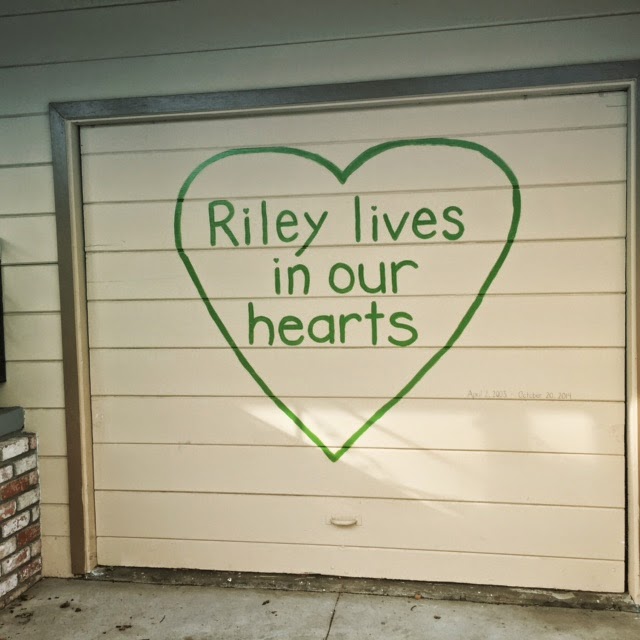
And as I painted the garage door with the words: "Riley lives in our hearts," I realized that painting things green doesn't actually do anything, aside from making me feel like his spirit is slightly less invisible. But that's probably only to people who are looking for it in the first place...and, of course, to our across-the-street neighbors. 

Tuesday, February 03, 2015

Grief and clothing

Wearing my dead son's clothing
Riley's clothes neatly folded
Snug tee shirts with baseball logos or stripes that fall just below my bellybutton aren’t really my style. But my son’s shirts somehow fit around my torso and fleshy, upper body girl parts. For three days, I wore them hoping to channel my now dead 6th grader, pleased, yet bewildered that this stack of unused clothing used to cover his body. Everything he wore was baggy. It was only when he stripped down without a thread of modesty at bedtime was I reminded of his thinness and how his bones were held together with so little.

Late Sunday afternoon, I tried to complete an outfit. Sliding the shorts up my legs, they got stuck somewhere slightly above the knee. I was bemused that they didn’t fit. I thought they could somehow manage my grown-up body because we always had pulled the elastic so tight around his slim eleven-year-old frame. Surely there was enough cotton and elastic for me. Once I hiked them up as much as they could go, I stood in front of his closet for a bit wondering if I’d lodged them into my flesh just enough keep them in place. I mentally scanned my closet to imagine what I could wear that was long enough to make it work. But then I realized that I’d have to replace his tee shirt with something else, and wearing his tee shirt was comforting.

After removing the shorts from the mother's body, I folded them neatly and returned them to the son’s closet. From there, I went to his twin-sized bed, opened the comforter, and let it swallow me. Once inside, while wearing his tee shirt, the items on his side table caught my eye. I fastened his watch around my wrist, hung his Rainbow Loom necklace from my neck, and put his glasses on my face. From that perspective, while clutching the Freddies (his beloved penguins) in my arms, I flipped through the pages of the map book he made with his best friend, hoping to find him as I experienced the world from his vantage point. 

Friday, January 30, 2015

Every eight weeks

I donate in honor of Riley
I was reading a book at the juice and cookie table today about why people donate blood, and one of the stories really resonated with me. A woman wrote that while the doctors made decisions about her care, it was blood that saved her. Doctors could not have saved her without blood. Same goes for Riley all the years he was alive. 

It’s that time again, people. Every eight weeks. If you are eligible, please donate. Do it because giving feels good; do it because you can; do it to honor someone; do it because someone you love may need it one day. And it doesn’t cost you anything aside from an hour chunked out of your calendar. Just one hour every eight weeks. Make an appointment. My next one is already booked for March 27. Let me know if you want to go together.