AddThis script

Showing posts with label CHD. Show all posts

Tuesday, May 15, 2018

Grief and pointlessness

Riley's jerseys
Gray clouds were smeared across the San Carlos sky like a thick layer of jam on that Saturday morning a few weeks back. It was early, but not too early as I set up my stadium chair at the top of the bleachers. With my cup of decaf, I cornered myself, away from other parents as much as possible because I was solo that morning. C’s dad was out of town; C’s stepmom was out of town; my husband was working. It was just me and I hate mornings when it’s just me at the Little League game. I just don’t know how to fit in. So I put myself in the corner and pretend I’m invisible. Then I scan the opposing team for blond boys with blue eyes and glasses that I can pretend my dead 11-year-old son is there. So that I can cheer for him silently. So that I can pretend that Riley is still playing baseball.

As the innings progressed, the clouds thickened and then colluded to make everyone and everything wet. It started as a few drops, but quickly progressed into a downpour. After a few minutes of rain, the umpires called a rain delay. Most people -- including the kids from both teams -- moved under the awning of the snack shack. I pulled my hood over my head, but stayed put. If I didn’t move, then no one would see me. I felt like a deer, frozen in place in my winter coat with the hood pulled over my head in an attempt to stay dry and invisible. One minute. Five minutes.

The other parents eventually joined the kids under the awning. Why hasn’t the game been called, I wondered. But I couldn’t ask anyone. I don’t know how to talk to the other parents. Do they know I have a son named Riley? I don’t know how to talk about the score or the at-bat or the home run. It’s easier to stay invisible. Ten minutes later and the rain continued.

For the sake of my son’s health, I mustered the courage to approach the team under the awning. I pulled him aside. “Do you want to go home?” I asked. “The game isn’t over yet,” he said. “But you are soaked and it’s cold. I’m worried you’re going to get sick. And it’s just baseball,” I said. “It’s okay. I want to stay.” I said okay and went back to my wet chair in the bleachers. A few minutes later, the drops became less frequent and the umpires said the game could resume as patches of blue punched through the jam layer.

The children went back to their sides of the field, their dugouts. The parents reclaimed their spots on the bleachers.I could hear their voices nearby. They talked about the rain delay. They talked about the score. They scolded their children for not catching the ball when they thought they should have caught the ball. They scolded the teen umpires for calling their child out when they believed that their child was safe. They cheered when a bat made big enough contact with a ball that allowed their child to run to second base without the need for scolding.

It’s all so pointless, I kept thinking. All the cheering and scolding and celebrating and complaining. But then again, what’s the point of anything? It’s all just a way to pass the time, to get through the weekend. An excuse to take pictures to hang on the wall. Something to do as a family. I don’t think it felt pointless when Riley played for all of those seven years. It was a place that he felt normal. A place where a uniform made him look like all of the other kids who had two ventricles and a spleen and their heart on the correct side of their chest pumping blood to its neighboring lungs and then to the far reaches of the body with ease. A place where I let myself believe that he was just like the other kids. And that him growing up was just a given instead of a fear sewn into my DNA that expanded and contracted with every breath.

Monday, February 05, 2018

Grief and my beating heart

Sunset, before the world falls into black.
Pressing into my jugular, I wait. Wait for the irregular heart beats--they don’t happen much anymore. Stress, they said. But I listen for them with my fingers. I want wrong beats to exert themselves. I keep anticipating more palpitations. Side effects from the medicine, they said. It’s terrifying when they happen, especially if I’m driving and everything falls into a black tunnel for a moment. But there’s something about wrong beats or extra beats that make me feel connected to Riley. Grief broke my heart. So I listen with my fingers pressed into my neck, feeling each beat as it pushes back against my fingers. Waiting. Waiting. Waiting for my heart to be in sync with his. Just like it used to be.

Monday, May 23, 2016

Grief and being closed

Open, closed. Open, closed. Open, closed. Like a heart expanding and filling, then contracting and emptying, it’s the way I am moving through the world. For brief periods of time, I open to be in the company of others. And other times--most of the time--I shrink into myself, my tiny, isolated world of words and stacks of photos from when my son was alive. I am open; I am closed. I am open; I am closed.

Right now I am closed.

mother grief
A rainbow lands on Riley's art
As I lie in bed and sense the afternoon sun, a finger of light lands on my index finger like tiny hummingbird feather. I try to feel it. I want it to be warm and weighted like my boy’s hand. I search myself to remember what my son’s hand feels like. I held it thousands of times without much consideration. Why didn’t I pay more attention? I can picture his little boy hand with dimpled knuckles. I can picture his middle-schooler hand with gnawed cuticles, the places where the skin had torn and bled. I can see his rounded fingertips, his nails so short from the constant nibbling. I remember the reddish blue nail beds. I so often look for that color on other children’s hands, but it’s not a color readily available on the playground or in C’s classroom. I cannot see it anywhere. That feather of light taps my skin. Hello Riley, I say to him.

In February, I was open.

I mustered the wherewithal to be open, to reach out and do the simple things that most people do without an internal battle--I got a haircut, I went for a walk, I had coffee with a friend. But then, like a scared turtle, I pulled my head back inside my protective shell to hide again. Maybe it was because April was so very heavy. There were too many things at once to make sense of.

Riley’s 13th birthday appeared on the calendar. My brain cannot seem to reconcile that he is now two different ages at the same time.

My stepson turned 12. How can the boy who is exactly one year and two weeks younger than Riley be older than Riley?

Another mathematical milestone demanded that we recognize that 18 months have been endured without him. 


My stepdaughter was in the ER and then having surgery at the same hospital where Riley exhaled for the last time. I 
even sat for a period of time in the same pre-op room where I last heard my Riley's voice. I love you too, mom, it said.

And so I am closed.

my child died
Riley in Bubblegum Alley
That list of reasons is me trying to apply logic to this illogical reality. I figure if I can point to things, it will explain the latest crying, the way I am avoiding friends. Another school year is winding down without him... Add that to the list. When I examine the cumulation of all of those things, it makes sense. Only it will never really make sense. I vividly recall school beginning, the mandatory first-day-of-school photos, minus one. The calendar is turning without him; the children are growing taller, the notches on the door frame inching up while he will forever be his height on his half birthday just nine days before that surgery that was supposed to fix everything. 

The leaves fall, they grow back and shade the patio, they fall and grow back again. They don’t know how to live another way. I don’t know how to live this way. And so I curl into myself, I crumple, and fall to the ground.

One day I imagine I will open again. I will be in the company of my safe people. In the meantime, I will talk to the light tapping my finger. I will concentrate on giving that light a feeling so that it will be like his hand holding mine, feeling his boy skin on my skin. And then it vanishes. The patch of light leaves me all alone with my broken heart, contracting and emptying.

Friday, April 22, 2016

Grief and Being Better

This is fascinating... I read today that my latest piece in Six Hens implied I was doing "better." You know, 18 months has passed since my son died, so I must be getting over that whole grief-thing. Having gone back and reread it, I understand why some people interpreted it that way. But in reality, I was so low--which really is just my new baseline--and then, during the month that my father in law visited, the manhole beneath me opened and I fell through it and landed even lower down in a pile of rubble. Yes, I managed pick some of the rubble from my wounds. I even found the gumption to try and climb out of that hole. Each time I met up with a friend or went for a walk, it was me inching up that jagged wall.

San Francisco Bay to Breakers
Powerful me, circa 2001
Imaginative readers probably pictured me hoisting myself up, ascending rock-climbing style to the top of a rock face or approaching the finish line of some race with my arms raised above my head in victory, concluding that I was strong and badass and overcoming the whole grief-thing. You know, mind over matter. I can understand why it came across that way because, sure, I did things I hadn't done since my 11-year-old son died, like text friends, go for a couple of walks, and get my hair cut. At the end of the month, though, I wasn't at the top of some rock face or near a finish line with muscles bulging from my 5'6" frame. No, let's say more realistically I was covered in abrasions and blisters and probably back to my dismal baseline. And that was only because I figuratively hollered from the bottom of the hole and my friends came to my aid and figuratively dropped some ropes down to me.

To be fair, I could have landed at the bottom of that hole and lay in the gravel, whimpering quietly. I could have ignored the bits of rope that were dropped down to me. But scratch the ripped version of me climbing triumphantly to a mountain top, shall we? Try this image instead: A whimpering me lay at the bottom of a hole and cautiously called out--not wanting to disturb anyone. Then the ropes that came down somehow magically wrapped themselves around me and my friends with their powerful friend muscles did the work. Yes, I asked for help, but I must give credit where credit is due--they pulled me up.

I read an article yesterday about raising children with invisible challenges or disabilities like ADHD or autism. It said that it's helpful for parents to compare invisible challenges with physical disabilities to help people understand. Here's her example:

I am raising two older boys with physical challenges...I have never - ever - had to justify a single accommodation that they required. Can you imagine a school official saying...."well, you know if your son just tried a little harder, he could get out of that wheelchair and run up the stairs and then we wouldn't need to build a ramp." Are you cringing yet?
Yes! That idea does make me cringe. We'd never think a child in a wheelchair just wasn't trying hard enough to use her legs. That analogy got me thinking about the invisibility of grief which makes it difficult to describe and difficult to understand. Over the last 18 months since Riley died, I have tried to come up with a useful physical analogy to describe my parent grief. My latest is that losing him is like losing my arms. Think about it. Think about what your life--or even just getting through a day--would be like if your arms were amputated. No fingers, no elbows, nothing. And while it is difficult to imagine things we haven't experienced, like that article, I suspect that imagining our bodies minus limbs is somehow easier than imagining our lives minus our living children.

bereaved mom child loss grief
Sibling grief art
Given that I’ve had arms all of my 42 years, life without them would never get easier. I would still be able to walk and move around, but every single thing would always be hard. I’m sure I’d figure out how to eat and brush my teeth, use the computer and the toilet (but not at the same time), but I would never be okay with losing my arms no matter how many years went by and how many beautiful people I met at occupational therapy and support groups who also had lost their arms. I would always, always miss having arms.

Grief is invisible, and it’s hard to understand or empathize with if you aren't enduring it. So this analogy is my (latest) effort to help the non-grieving world (and the not-yet-grieving world because life is a series of losses, is it not?), what losing Riley is like. I will never be okay with losing him and every single thing will always be hard. Always. Because, like amputation, death is permanent. I would always, always miss having arms. I will always, always miss my son. Even if I'm trying to get out and do things that I did before Riley died, I will never be "better." I will only be different.

Sunday, February 28, 2016

Grief and CHD Awareness

bereaved mom
Lost boy
I'm not really sure what changing my photo on Facebook does to bring awareness I'm not sure what posting that same picture on this blog does either other than show off one of my favorite pictures of Riley sitting on my lap, both of us so bursting with loveBut February is Congenital Heart Defect Awareness Month, so here I am on the last day of February posting my favorite photo enhanced with red and blue to make you aware of something or other.

And in the spirit of all that awareness, here are some things to be aware of:

* I feel angry a lot of the time. Angry at my husband. Angry at my kids. Angry at the dog. Angry at other parents. Angry at you for having living children. Angry at you for laughing and being able to go to parties or weddings or school events without the underlying panic. Angry that I feel so lost and unsure and insecure. Angry that when I have to pick my son up from a friend's birthday party that I end up crying outside, too scared to face the other parents inside. All of that makes me feel pathetic.

* On some days, I feel like I'm losing my mind. Like coo-coo crazy. I imagine that I could easily tip over some edge and end up in a mental institution with white walls and little cups of pills. There's a lot of chatter in my head about who is good and who understands me and who I can let visit my grief planet and who is just trying to lure me off of this planet to some other planet because it would be easier for them if I didn't live so far away in my crazy coo-coo planet where I really struggle with who I can trust. When I'm lost on my coo-coo planet, it feels like everyone is against me, trying to make me forget Riley. Trying to make me be normal because it would be so much less awkward. Fortunately, not every day is a coo-coo day.

* I don't like leaving the house. When I do, it's often related to grief--couple's therapy, grief group for parents, family grief group, individual grief group. Then there's visiting Riley's memorial in the hills near our house where I walk the dog. I do leave the house for other reasons, like teaching art and Little League games, but that is usually when the anger starts bubbling as I hear the chatter of normal people around me.

* I'm sad all of the time, even if I don't look sad on the outside. I owe that nugget of clarity to C, who was only eight years old when he uttered it.  I give him a lot of credit for summing up grief much better than most adults. Anyway, I feel seriously sad. All. Of. The. Time. Bags of baby spinach at the store make me cry. So does garlic. Pasta. Basil. Olive oil. Corn Flakes. Kids in baseball uniforms. Kids with rolling backpacks. Kids in glasses. Blond boys. Little kids with fat cheeks. Crying babies

* I can't understand how I could ever possibly lead a happy life. I sometimes think that this life here on earth is actually Hell. There is just so much suffering. Everywhere. Yet, we don't talk about it most of the time. Put on a happy face, go to work, visit friends. Talk about the ball game and not that serious stuff that keeps us up at night or makes us fantasize about that little bottle of pills we have in the drawer that could help make it all more tolerable. Only I don't know how to do that anymore. I don't know how to fold it up, tuck it in, put it away. So I wear it like soup I spilled down my shirt or like broccoli in my teeth--only no attempt to hide it. I don't know how to nor would I want to.

* I spend a lot of energy trying to figure out how to solve a riddle about why Riley died. If I solve it, it means he won't be dead anymore. So I use a lot of mental energy going through every single detail of his hospitalization, trying to figure out where it started to go wrong. How I could have made a difference, noticed something, asked the right question, or asked the wrong questions in different ways to come to different conclusions about how he should have been treated, with what medicines, with what therapies, with what tests. I will spend the rest of my days frantically rolling over every single thing until I figure it out. I sure hope that one day I'll be clever enough to solve it. That would be pretty amazing.

* Just like you talk to your kids, I talk to Riley. I'm the only one who can hear his replies.

* Riley sends me letters. When he sends them, they just appear in my head. And then I write them down on the wall under his desk in his bedroom.

* I fantasize about crashing my car. I can feel that urge sometimes. I'm just driving along and wonder what would happen if I pulled the steering wheel hard to the right or left. Then I could go be with him, wherever he is. But then I remember I have another son who needs me here on this earth. So here I am, even though that other thing feels really appealing, especially on the days when I feel coo-coo.

* Sleeping is my favorite thing. Riley isn't dead when I'm sleeping.

I sometimes fantasize about how my life would have been different if Riley had been born with a healthy heart. Not only did a congenital heart defect prevent him from having the luxury of growing up, he suffered too many times along the way. Too many tests, too many procedures, too many hospitalizations, too many surgeries. Other times, when I'm bargaining with the universe, I simply wish that he had survived this last surgery. Now that he's been dead 16 months, I wonder what he would look like, how tall he'd be. As an almost 13-year-old boy, he'd no doubt be changing, even though I'm convinced he'd still be sitting on my lap at every chance (see above photo). And since his surgery was supposed to give him more energy, I can't help but wonder if he would be able to go hiking or even just walk the few blocks home from school. 

One in 100 kids is born with a heart defect. Most defects are so minor that they will never need any kind of intervention. For the small percentage of those who do need help, there are simple procedures that can be done in the cardiac catheterization lab. For an even smaller percentage, there are surgical fixes that undo whatever nature messed up in the first place. Then there's even the smaller percentage who may need multiple surgeries and will never be fixed. 

Riley was the love of my life. CHD sucks. And now that you're filled with all of that awareness, let's be honest, shall we? It doesn't change a single fucking thing. 

Thursday, February 11, 2016

Grief and being needed

My bedroom is where I work; it’s where I sleep; it’s where I grieve; it’s where I hide. This morning, it is also where I eat my oatmeal.

Chestnut blossoms
When I look past my bowl out the window, there is a wall of green. A few days ago, I noticed a purple bush splashing itself against that bristly green wall. In another few months, the chestnut trees will extend their blossoms like hands offering bouquets of pink petals.

Not long after eating, an email arrived in my inbox. It was a request from another mom, asking if I could help out during an art lesson at my son’s school. My first reaction was No, I don’t want to help out with another art lesson. I am at school enough teaching my own son’s class art. Why would I want to help out another class?

Being a volunteer art teacher for my son’s 4th grade class was not something I wanted to do, not this year, anyway. I had only showed my face at school two or three times when C was in 3rd grade. They were: the day C resumed school after Riley died, for C’s parent/teacher conference, and for his glee concert. That was enough; it was all I could manage in grief's wake. And on the first day of school this year, it was another anxiety-driven morning of me hiding under my hat away from the faces of other parents scrutinizing me (or at least that’s what it felt like). During “Back to School” night, I stood next to the door, so that I could bolt if need be. I have found that having an escape route makes going to these school things slightly less intolerable.

Dali's "Swans Reflecting Elephants"
But I taught 4th grade art when Riley was in 4th grade. It seemed appropriate to teach it again for his brother this year. So that’s what I have volunteered to do. On the day of our first lesson, I felt my body shaking as I puttered around the art room that feels a lot like the inside of a double-wide trailer. As I waited for the other volunteer parents to arrive, I stacked paper and opened plastic buckets with sketch pencils. Cold fingers reached for the school’s copy of Salvador Dali’s “Swans Reflecting Elephants” while nerves moistened the fabric of my blouse.

When the others arrived, I said hello. They said hello back. One mom gave me a long hug; the others just went about their business, asking about set-up and materials needed for the lesson. With the beating of my heart audible in my ears, I watched the clock counting down the last minutes before the children arrived and I would be on. It felt impossible to just pretend everything was normal. I had to say something.

“Hey,” I just wanted to thank you guys for being here,” I said as they covered the tables with bits of plastic cloth. “And I just wanted to put it out there that I’m feeling terrified. Terrified of the kids, terrified of all of you. Since Riley died, I’ve really struggled being around people; all days are hard in their own unique way. I’m doing my best, and please don’t ever take it personal if I’m short or seem angry. I’m just struggling and lost in grief.”

“Thank you for being here, Suzanne. And don’t worry about us,” one mom said. She wandered off to put sketchbooks on desks.

Another mom came over. “Did you realize that this is the same room we taught 4th grade art in last time?” I hadn’t, but she was right. This art room used to be one of the classrooms. It was Riley’s classroom and her son’s classroom when they were in 4th grade together. It felt fitting. A long inhale followed by a long exhale stabilized the off-kilter feelings I had after that realization. How had I not made that connection? It made me feel like Riley was there with me, helping me through. Tears threatened to streak my face at the memory of all the lessons I had taught in his class three years earlier.

Just then the kids walked in and lowered themselves to the floor near Dali’s painting. After introducing myself, I started talking about the artist and our exciting lesson in which they would make their own magical chimeras with oil pastels and watercolor paint.

Friendly 3rd-grade waiter at Scat Cat Cafe
The memories of that first lesson washed over me as I re-read the request to help out with the other class’s art lesson. What I realized--at least in this very specific moment--is that I’m wanted. Even in grief, I have something to offer. So often, I feel like a burden, that my grief is burden, that seeing me is a reminder that children die. And no one wants to think about children dying. It's such a downer. And so it’s easier if I’m not around, if I don’t make eye contact, if I don’t remind you of my dead son or dead children in general. I feel this way with my friends, with my acquaintances, with my family, with my neighbors, with the parents at school. I have felt like eventually everyone will smarten up and realize that this whole grief-thing just isn't going away, that it's a real drag, and that having a relationship with me just isn't worth their time and energy. And then they will go away, just like I knew they would.

Many months ago I had a conversation with the mother of one of C’s friends. She told about the teacher at her son’s preschool who lost a child. The teacher feared that no one wanted her around either. That she was unwelcome, unwanted. The parents reassured her that they did want her around, with her grief, her tears, her unpredictable emotions. I realize that’s how I feel, too. And maybe that’s why I’ve been neglecting my friendships, not responding to texts or invitations to get together. Because even though people are reaching out, I imagine that they can’t really want to spend time with me.

But here is an email requesting my help, even if it's only in this tiny, we-are-short-on-volunteers way. Perhaps, maybe, just maybe, I have something to offer after all.

* I found out later that day that the email had been sent to the entire class list, even though it looked like it had been sent just to me. No harm, no foul, but I was surprised at how it made me step back and analyze my relationships with my community.

Wednesday, January 13, 2016

Grief and Puerto Vallarta

child loss
Showing Riley our view in Mexico

It was the day after Christmas in the Puerto Vallarta airport. My husband and I just spent a week in a sleepy beach town known for its gentle waves that entice surfing newbies onto waxed boards an hour north of there. As we sipped lattes while waiting for our boarding time, a familiar face passed as she headed for the restroom.

No, no, no, I panicked, feeling bemused about how there could be an acquaintance nearly 1,900 miles south and two time zones east of our Northern California home. We ran away from the holidays and the merriment of friends and acquaintances and their living children to a remote part of Mexico where I imagined hearing the words Feliz Navidad would feel less painful than hearing their English equivalent. But in that moment, in the busy terminal, there was the chance of no longer being anonymous. Anxiety replaced the serenity I found in the days spent perched above the sandy shoreline, and peppered with my enthusiastic, yet flawed Spanish.

Why would the sight of an acquaintance cause emotional distress? Because I have no idea what that person will say to me if we catch each other’s eye. While I can guess the topic--my dead 11-year-old son--I suppose it’s the approach, rather than the topic itself, that I most dread. Because I love talking about my son Riley.

Just like you enjoy bragging on your kids, I like bragging about him. I want to tell everyone about his quick plays at second base during his seven years of Little League, about the short stories and poetry he wrote, about his love of maps, of his siblings, his interest in penguins, hot sauce, and his desire to open a restaurant one day. We used to joke it would have been called, “Riley’s Salads and Fried Things” or “Riley’s Tofu and Salads.” His favorite dinner from the time he was just two years old was salad. I have photos of him, fork in hand, to prove it. Caprese sandwiches were his favorite. He loved that he had Italian heritage and enjoyed making his family bruschetta and croutons; he liked eating cloves of raw garlic. I can remember sending a little three-year-old boy into the backyard to pick handfuls of basil for batches of homemade pesto that would be spread on to thick slices of crusty bread.

But as a bereaved mother, I have found conversations with acquaintances to be painful, not because I am asked to speak about my son. But because the weight of the conversation is so often plunked down on my wounded heart with good, but flawed, intention. How are you? or even Sheryl Sandberg’s modified How are you today? sounds innocent enough. But in order to answer, I must access myself for this other person, in what ultimately is a passing moment in their daily routine. To me, it is so much more as I frantically scan myself in an attempt to sum up what it is like to live today without my son for a near-stranger. Okfine, or hanging in there are grossly inadequate and false


The moment’s complexity is exacerbated because interacting with humans with healthy, living children in general, is--quite frankly--a skill I have yet to master. You see, I'm still largely terrified of all of you. I'm also confused by all of you; your smiles, laughter, or your annoyance at traffic or the wrong latte at Starbucks. To be fair, I imagine your lives are far more complex than what I catch a glimpse of as I blast through my kid's school with my head down. We share the same roads and schools and grocery stores and oxygen supply, yet it feels as if we exist in parallel worlds. Most of the time I want to be invisible; yet, having you ignore me is a different kind of trauma. You're dammed if you do; you're dammed if you don't. I don't make the rules; I'm just stuck in this miserable grief game of trying to figure out how to exist among the living and having no clue about how to do it

To avoid that potential airport interaction, I turned around, slunk down in my chair, and watched the three kids opposite me--particularly the boy who looked about the same size at Riley who wore a “Most Valuable Player” t-shirt--eat pizza and chips. And I hid under my hat. I’m sure she didn’t recognize me with my short hair in the first place, anyway. 

Monday, December 21, 2015

Grief and A Leap of Faith

my child died CHD
Gorgeous art from Issue 3 of Six Hens
* Note to reader: This is the "Letter from the Editor" from my literary magazine Six Hens. Issue 3 launched today. Feeling enormously proud. Read, feel something, share... *

A nurse tapped on the door before turning the handle. “I thought you’d want these,” she said as she approached me. She offered two Polaroid pictures of my newborn. Curiosity or instinct elevated my hand to receive them. “He’s beautiful. Do you have a name?” I shook my head then parted my lips to thank her. My words were reflex rather than gratitude.

She switched to nurse mode, asking when I’d last urinated or if I’d passed any clots larger than my fist and whether I wanted to breastfeed. When I said yes to that last question, she said she’d arrange for a lactation nurse to explain the basics. I didn’t protest, although I couldn’t understand how I could learn to breastfeed without a baby. Then her cool fingertips pressed my doughy abdomen. After her exam, I felt her access me in a different way. “You need to name him,” she said softly but firmly. That wasn’t any of her business. It wasn’t part of her job. But she must have heard about his x-ray, the one that showed his heart on the opposite side of his chest. She must have seen paperwork declaring “probable heart defect.” She must have known it was serious. She must have known that naming a newborn—even one with scrambled up insides—was more important than the possibility of him dying nameless.

Chalky morning light muted pinks and blues on the walls of the small room in the recovery ward of that Northern California hospital. It was before rush hour on April 3, 2003. Blankets and pillows swallowed me, but I was cold for the first time in months. My eight-pound-two-ounce furnace was in the nursery somewhere else on the floor. My fingers gripped the edges of the Polaroid pictures, which were face down on my lap. I flipped them. They were almost identical, showing a round-headed baby, eyes closed, head turned left with a breathing tube disappearing into his mouth. One image showed his torso where the umbilical cord stump had been removed. His skin was orange-red from iodine, which could’ve been mistaken for blood. I had read that a newborn’s stump normally fell off several days after birth, revealing a bellybutton. Our son, who we had yet to name, needed his cut away to use as a place to insert an IV.

I thought back to the moments after he slipped from my warm body into the cool, room-temperature air. As a hushed urgency of doctors escalated to my right, I noticed the baby was silent. “Ken? Is he breathing?” I asked my husband. He was, Ken said with his arms crossed tightly over his chest, “but something is wrong.”

A few minutes later, a nurse asked if I wanted to hold him briefly before they took him to the nursery for more tests. “I don’t think so,” I said unconvinced. After twenty hours of labor, my body was relieved to be free of him.

“You have to hold him,” Ken said. I reluctantly agreed. With my baby wrapped like a burrito in a blue, green, and white hospital blanket, the nurse set him on my chest so that I could see the creature that had been rolling around in my tummy for months. He wasn’t the most beautiful thing I had ever seen. His skin looked ashen, his face was contorted, and he was stretching his neck; it looked liked he was in pain. It felt like everyone waited for me to ooh and aah over him. But I didn’t. I just looked at him, at his twisted expression. The nurse said they had to take him. I didn’t want him any longer anyway. I felt faulty because I was not instantly in love.

When my husband returned to the recovery room, he explained that a neonatal transport team was on their way to ferry our baby to UCSF more than fifty miles south. I gave him the pictures. “You can go see him,” Ken said as he studied the photos, “if you’re ready.” When I didn’t respond, he lowered himself into the plasticky armchair to my left and took my hand. He looked thin, and dark patches underlined his pale blue eyes. It had been nearly nine hours since an initial newborn assessment forked us into separateness; I refused to accept that things were going horribly wrong. Surely he was just exhausted from being born; I was exhausted from giving birth. A few minutes later the nurse returned and parked a wheelchair next to the bed. I hesitated. Did I want to see my baby? A good mother would want to. Surely I was a good mother. Like a sack of rice, I slouched as Ken rolled me along. In a hallway carved of fluorescent light, it felt like we moved forward and backward simultaneously.

When we arrived in the nursery, I don’t remember seeing any other babies or cribs. Instead, the small space was crowded by neonatal transport experts. They prepared a special plastic box—a high-tech mobile incubator that would be placed in their ambulance. Plexiglass and a wall of EMTs separated me from my son. Through uniformed bodies, I could see bits of baby. An hand here, a knee there; so tiny, barely human under the web of intervention. He was enclosed, packaged, foreign. I wish I’d kissed his moist skin, inhaled his mossy smell when I had had the chance. The team assured us that he was stable and would be in the best of hands on his fifty-six-mile ride to UCSF, one of the top pediatric cardiac centers in the country. And then they were gone.

Kneeling in front of me as if he were about to propose, Ken’s warm hands reached for mine and pulled them to his damp face. Holding my gaze for a moment before putting his head in my lap, there was nothing to say. My fingers pushed through his trim brown hair and convulsions began. Unfamiliar sounds built in my diaphragm and erupted from my mouth, penetrating an otherwise quiet corridor. Nurses walked around us. No one asked us to move. We were left to mourn that moment. His birth. The unknown.

Eventually Ken pushed himself from the speckled linoleum and assessed my droopy posture. He brushed matted hair from my eyes. In whispers, we decided he should drive to UCSF, the hospital on a hill in our old neighborhood near Golden Gate Park, instead of waiting three more hours until I was allowed to be discharged. With that, he wheeled me back to our tiny room and helped me into bed.

“We have to name him before I leave,” he said with arms folded. I looked at his body, his denim pants and T-shirt, his waning hairline. Only in a twisted world would I debate pros and cons of naming my baby.

I hugged myself, squeezing my arms, rubbing open palms along my sides and over my vacant, shrunken stomach. “Okay,” I said after a long silence, still unsure. “Where’s the paperwork?”

He grabbed the form from the end table and clicked the end of a pen. The lines were long and blank. Without knowing his diagnosis or prognosis, I thought of the nurse, her prodding, and assumed a named child would be harder to forget than an unnamed child. He picked up the Polaroid photos and put them next to me. I studied the baby’s face and hoped it would tell me what it should be called. The blankets vibrated as my muscles shook. The stack of thin layers over my limbs didn’t seem to make a difference. After sinking down further, my eyes closed.

“We both like Riley,” he said, doing his best to keep me engaged.

My eyelids rose and focused on him. He nibbled at his cuticles as he waited for my response.

“I still like Mackenzie for a middle name,” I whispered eventually. “It means son of Ken. Then everyone knows you’re his dad. No one ever wonders who the mom is.” With that, he pushed pen to paper and our son’s name appeared. I sunk lower, clutching a pillow. He kissed my forehead, gathered his things and left.

It was incomprehensible. Riley was gone. I imagined miles of highway separating us, when nine hours earlier we had been connected. His flesh inside mine, held safe with breath and heartbeat. Nothing felt safe anymore. Ken drove home for a shower and fresh clothing before braving that unfamiliar San Francisco hospital, where he would start learning about our imperfect son, a baby I grew so horribly wrong.

It was just me in that little room. I had labored. I had delivered. But I was alone.

I didn’t know it at the time, but naming Riley despite terrifying uncertainty was a leap of faith. It was me desperately wanting him to be okay, hoping it was all a misunderstanding, a mix-up. It was also the first of many moments that define this mother’s love during my son’s truncated, eleven-year lifetime. He would have turned twelve on April 2.

Check out more powerful writing in the third issue of Six Hens!

Suzanne Galante, Editor in Chief

Thursday, November 05, 2015

Grief and scowling

mother grief child died
Tile at Riley's elementary school
My husband was not home for dinner Tuesday night. He was at a school meeting. I sat at the table with three loud children. Enthusiastic children. They were excited about the cheesy garlic bread I made. They wanted to grate mountains of cheese onto their spaghetti. They did not like the look of their apple and beet salad with walnuts. But they laughed. They hummed. Told jokes. Asked for seconds of bread and pasta and cups of water. Said please and thank you. They were just being themselves.

I scowled at them.

I couldn’t wait for mealtime to be done so that I could excuse myself and retreat to my quiet bedroom. I spend a lot of time in my quiet bedroom these days. But just before people were done eating, my nine year old caught my eye in a lull in the hullabaloo and said: “Mom, I want to apologize. I know we’ve been acting a little crazy. And it seems like it’s really upsetting you.”

Wow.

Despite their version of craziness, they see what’s going on. How sweet of him to notice. At the same time, how sad that he’s noticing. How sad that mom was scowling in the first place. Scowling so much that my son felt the need to apologize. I said thank you for noticing. I told him it wasn’t about them having fun; it was just about me feeling sad about Riley.

He was right, though. I was really upset. The things I used to enjoy about my kids are upsetting now. I get mad at them. I scowl. I don’t like fun. Or laughter or any kind. Mealtime used to be a joyful event. A few months before Riley went into the hospital last year while my husband was out of town, we spent an entire meal only singing to each other. As in, anything that needed to be said was sung, not spoken. “Would you please pass the cheese?” was a melodic request followed by: “Yes. I will pass the cheese, pass the cheese, PASS the cheese.” Think Bohemian Rhapsody. It was the best. 

Laughter is now grounds for disgust. I just don’t know how to let things roll off of me anymore. Or really be in the moment. I’m lost in despair because of what happened to Riley; I’m lost in anguish because I have to live this life without him. Most of the time, I feel like I’m in sensory overload. It’s like the whir of a stove fan overpowering most of what’s going on around me. It makes it hard to hear things. It makes is hard for me to concentrate. Before Riley died, I struggled when there was a lot of sensory input around. When the kids were talking and there was music playing and the oven fan was running, my brain was stuffed with too much to process. Now I feel that way all of the time, even in a quiet room. That is my baseline. I’m always running at capacity. Add three enthusiastic voices singing and laughing and talking over each other and my brain feels like it’s going to burst. Hence, the scowling.

If my brain were a balloon, and grief was water, my brain would look strained by the amount of liquid forced into the allotted space. Grief has exceeded its capacity. Each person or sound is like turning on the tap even though the latex has no room for another drop. Even kids’ laughter. Or maybe I should say especially kids’ laughter. My brain cannot take the input. Despite the talks we’ve had about them feeling sad on the inside even though they look happy on the outside, it’s hard to accept. All that laughter feels like a betrayal of the truth. All that laughter is stretching my brain beyond capacity to tolerate my reality.

There are times that I can manage, that I enjoy being with the kids. I like reading together before bedtime. It doesn't happen very often, but I like it when it does. It's a sit-and-be-quiet time. We are together in a way where I don't feel overloaded. We read Riley's favorite books or talk about whether Riley would like this or that in the stories. I can almost imagine that he's there listening, too. Although, I'm sure he was also there laughing at the table, making jokes, singing along, sprinkling hot pepper flakes on his dinner, then lifting his shirt over his head, spinning it around like a lasso, trying to get everyone to laugh.

I really don't know why I manage one, but not the other. I could speculate, but I think I'll just be grateful that there are times when the scowling gives way to togetherness.

Saturday, October 24, 2015

Grief and Riley's Handprint Memorial

I am truly humbled by all of the people who came over to participate in our memorial. It was healing for me to see that so many people are still thinking about Riley and to be surrounded by so much love on this especially painful anniversary. We made a time-lapse video to capture the transformation of our garage door. Watch it, and let your heart soar.


Tuesday, February 24, 2015

Grief and judgments

Grieving my son
Riley memorial at Pulgas Ridge
A few days before heading to Hawaii with three girlfriends to grieve and reminisce about when our children were babies, I went to the nail salon to have a manicure and a pedicure. I’m still not sure why I went to the nail salon in my town given that I’m currently afraid of the general, not-grieving population, but that is where I went—probably out of habit. Cautiously inching along the shop’s long hallway, I surveyed the other patrons looking for familiar faces from under the brim of my cap. There were none and I felt slight relief that I could be anonymous as I indulged in something so trivial as trimmed cuticles and brown nail polish.

Not long into my pedicure, a woman was seated to my right. Her young daughter was seated to my left. They chatted about their day and the brother at school and I decided to use that moment as an opportunity to say out loud that my son had died. I could practice saying it to this stranger. I could ask her about her kids and we’d talk about our children, so normal.

“How old is your son?” I asked during a lull in their conversation, wondering if he knew Riley or about him. “And does he go to Brittan Acres?” She said he was about the same age as C, but goes to a different school. Like the moment before a falling glass meets the ground, I knew our conversation was about to burst into tiny shards of shattered thoughts. I set it up and waited for the impact, the mess of my reality. “Do you have other children?” she asked. “I used to have a 6th grader,” I muttered. That was all I managed. Once I said it out loud, I didn’t know how to say anything else. Honestly, I wasn’t even sure she heard me because I said it in what felt like a whisper, forcing those broken words from my lips. And the words felt so jumbled as they fell, that I wasn’t sure—even if they were audible—that they weren’t nonsensical.

I wanted to try speaking my truth in a way that made it sound normal, given that it is anything but normal. She was my guinea pig. She was silent after I spoke, we both were. Our conversation was broken, jagged, a messy beast to slowly back away from. The fact that was I was even getting my nails done felt so wildly inappropriate. How could I possibly be getting my nails done given that my son had died? How could I possibly do something so frivolous given that something so profound had happened? I felt ashamed.

A few minutes into the silence, the nail technician moved me to a different seat so that my toes could dry under the tiny foot fans. Once they were completely dry, I thanked her for taking care of my feet. Then I slumped out of the shop avoiding eye contact with the mom who I envisioned was on the verge of shouting at me: “Your son just died and you’re getting your nails done?!”

That awkward encounter played in my head over and over. A couple of weeks later I got an email from that stranger. She said in her message that she had recounted our interaction to a friend and that her friend replied: “You met Riley’s mom,” and pointed her to this blog. She told me she wished she’d given me a hug that day. Her message included a virtual hug. “No big words,” she wrote, “just know a total stranger has your heart and mind in her prayers.” Her note was filled with compassion. And she didn’t judge me. Quite the contrary. She wrote: “AND I thought how WONDERFUL it is that you are letting other people take care of YOU. Whatever it is I would imagine each part of YOU needs nourishment—your heart, your mind, your feet, your soul!!!”

I want to believe that the chance encounter that led to that email from a stranger was the universe’s way of saying it’s okay to take care of myself. It’s okay to leave the house. It’s okay to have my nails done, go for a hike, drink a latte in a coffee shop. Maybe no one is judging me even though it feels that way. I suspect my biggest obstacle, the biggest critic, the most judgmental person approving and disapproving of how I spend my time as I try to learn how to move among humans who haven’t lost children—sadly, is me.

Wednesday, February 11, 2015

Grief and paint

My son died
Today's project: Improved garage door
There is no coincidence that Congenital Heart Defect Awareness Day coincides with Valentine’s Day. It's the day of the year when heart defects make national news and stories about children battling against nature with the help of medical technology come into the spotlight. But in my family—and probably in many families who have a child with a CHD—there really isn’t much to differentiate CDH Awareness Day from the other 364 days a year because there is no such thing as forgetting about it, even for a single day. It’s always there, beating in the background of our lives. With every medicine dose. With every visible (and invisible) scar. With every extra doctor appointment, hospitalization, and blood test.  

Four years ago, I tried to reclaim Valentine’s Day as the one day of the year that I would forget about congenital heart defects and just be in love the way that Hallmark intended. In love with my children, in love with my boyfriend (now husband). I thought I deserved that one day off, even if Riley didn’t get to take a day off from his medicine or have a day where running—or even walking—was easy.

Now that my son has died, I won't even pretend to imagine a day without CHD awareness. He is synonymous with it, and he is everywhere. Even when I'm not looking for him. As I checked in at the lab this morning for some routine tests, I saw his health insurance card and realized that there will never be another day when I present it to a receptionist at any doctor's office. As my blood was being drawn, I thought of all the blood tests he’d endured during his lifetime. When I was at the library, I found out that his card had expired. I paid the overdue fines accumulated when he was in the hospital and felt another loss realizing he won't be checking out any more books. I renewed his library card anyway. As I considered the Valentine's Day card I need to decorate for his brother's school party, I was reminded of CHD Awareness Day, the official day that everyone is supposed to care. The day when people like me want to think that all those news stories and ribbons actually make a difference. 

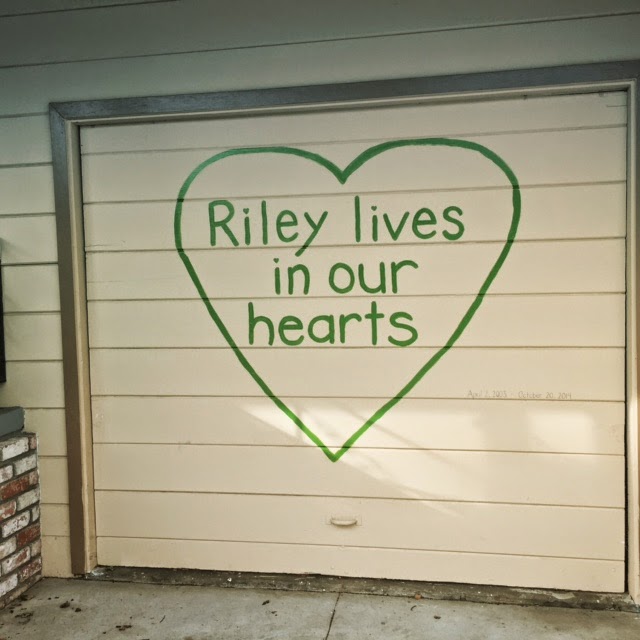
And as I painted the garage door with the words: "Riley lives in our hearts," I realized that painting things green doesn't actually do anything, aside from making me feel like his spirit is slightly less invisible. But that's probably only to people who are looking for it in the first place...and, of course, to our across-the-street neighbors. 

Friday, January 30, 2015

Every eight weeks

I donate in honor of Riley
I was reading a book at the juice and cookie table today about why people donate blood, and one of the stories really resonated with me. A woman wrote that while the doctors made decisions about her care, it was blood that saved her. Doctors could not have saved her without blood. Same goes for Riley all the years he was alive. 

It’s that time again, people. Every eight weeks. If you are eligible, please donate. Do it because giving feels good; do it because you can; do it to honor someone; do it because someone you love may need it one day. And it doesn’t cost you anything aside from an hour chunked out of your calendar. Just one hour every eight weeks. Make an appointment. My next one is already booked for March 27. Let me know if you want to go together.

Thursday, January 29, 2015

Grief and time

When babies are brand new, we talk about how old they are in days, then weeks, then months. Eventually, we move on to years and halves. I have an 8 ½-year-old son. I had an 11 ½-year-old son. That organizing of time seems to be happening in death as well. Right after Riley died, it was, how did he die four days ago? Then, how did he die two weeks ago? And when I started writing this, on the 20th of the month, I wondered how it could be that he had been dead for three months.

How do I keep living when he is not? The months keep piling up without him.

Top of Mauna Kea, elevation 13,796 in honor of my son
A weeklong retreat to the Big Island earlier this month gave my aimlessness shelter. While being aimless at home feels like laziness, being aimless in Hawaii with close friends felt natural. So many people are on vacation and being aimless is often the point of being on vacation. An entire day was spent in a cabana crying and laughing, the ebbs and tears flowing and retreating like the water pushing forward along the sand and then receding into its own vastness. Emotions rode that surf as it gently tapped shore and simultaneously pounded the rocks 300 feet offshore. They were both of those things at the same time, not unlike when I can laugh and then instantly feel pummeled by the waves of grief pushing me under every time I notice his absence, which is constantly.

One day we ventured to the highest peak in Hawaii, Mauna Kea. There were snow-covered rock faces and thin air. The elevation changed our breathing and made our motions slightly slower. Being there was profoundly beautiful, yet ordinary for most humans with healthy anatomies. I felt lightheaded and heavy-hearted. I had avoided elevation most of Riley’s life. How could I go to elevation when he could not? Yet there we were on the top of that mountain for Riley. At the Celebration of Riley's life, a friend distributed wooden token that he had had made. One side says, Climb a mountain in Riley's memory. The other side has a picture of Riley's likeness. We honored Riley on that mountaintop and reflected on all that has happened from that new perspective. Two of my kids had painted stones to leave there. The idea was that we could discover them during a future visit. The perfect hiding spot was under a large volcanic boulder with a bit carved out on one side. I pushed the stones in and covered them with rocks.

The process of burying those stones was surprisingly painful. Leaving them behind felt like abandoning Riley alone in the cold, thin air. It was like I left pieces of him unprotected to endure the elements without me looking out for him, without me taking care of him. No, the stones aren't actually my son, but the symbolism was not lost on me.

Returning to my Northern Californian town was unsettling. Being aimless here feels much less acceptable. There are routines and schedules and lunches to make, days to endure, weeks to pass. And soon enough the 20th of the month will reappear. Every single month, round and round we go, the accumulation of life without him. Eventually October will come around and stab me with each of its passing days. One year, then two, and then somehow my 8 ½-year-old son will surpass my 11-and-a-half-year-old son in age and the younger brother will become the older brother.

Sunday, January 04, 2015

Grief and light

As I sat on the sofa in my friend’s mountain house, a ball of light burst onto the painting of trees opposite me. The condensed glow was the tired afternoon sun splashing its last rays before drowning, and I was entranced because in it, I saw you, sweet boy. That splash of light was you in the room with me in the mountains, a place we didn’t go together when you were alive because elevation was not a place you were allowed to visit. The altitude could not provide you with enough oxygen. But there you were for a few minutes. And just like your short life, the glow inched to the edge and disappeared. Then the trees on the painting, just like my life, were dark. You were gone.

As the light glided across the picture, my husband sat and watched it with me for several minutes. He
Moonlight and death
Moonlight and death
saw a bright spot on the wall, the simplicity of the setting sun. I found the profundity of your soul or your energy or whatever you want to call that thing I need to believe still swirls among the atoms in my universe now that your physicality from it is gone. Nothing has face value anymore. It was you. I know it was. It has to be because seeing you in the inanimate things around me is the only option from now on.

Green was your favorite color. Your favorite shorts were green; your school binder was green; the comforter you chose for your bed was green. You wanted to paint the walls of your bedroom green. So what do I do? I see you in the greens of nature. I see you in the shade of green that we painted our front door. And just as I saw you in the vertical beam of light on the wall after your heart stopped in October 2014, I see you in every lighted spot the sun manages to push through window shades and door jams. But the fleeting beams of sunlight and the green paint and sprigs of grass and spindly pine needles are pointless because they bring you no closer.

Yet finding you all around is what people want me to do. “We do these things to remember him and to nurture this new relationship we have with him,” someone told me. I don’t want a new relationship with my eleven-and-a-half-year-old son. Yet, what choice do I have other than to adapt? The relationship we had is never coming back.

Even with the green and the glowing reminders, I don’t need visual cues to think of you. I breathe you; I exhale you; you are always sitting on my lap and holding my hand, in my mind. You are humming as you etch the math answers onto the paper, in my mind. You are peeling garlic next to me, popping raw cloves into your mouth, in my mind. You are organizing your bottles of Tabasco so that all of the bottles are neatly facing forward, in my mind. You are petting the dog, shouting: “Pepper’s tail just hit me in the penis” just so you could say “penis” loudly in the living room, your smile counteracting your attempt at indignation, in my mind. All of it, only in my mind.

Let’s be honest, shall we? Moving through grief is all about me accepting the world as it is, with exactly the people who tread upon it—no one more, no one less—is it not? One day I will go to buy groceries without feeling panicked when my husband is not in my line of vision. One day I will go to the café and order a latte with a friend. One day—I am told—that your memory will make me smile instead of burn with the need for your forgiveness. Only then will I stop pleading: “ Please forgive me, Riley,” my nightly mantra as I will you into my dreams.