 |
| My two boys |

Showing posts with label @six_hens. Show all posts
Showing posts with label @six_hens. Show all posts
Monday, February 04, 2019
Grief and wanting to die


Tuesday, October 09, 2018
Grief and chances
 |
| Riley - perfect at 11 |
Two nights ago, I was in an imaginary physical therapy nursing homes on the east coast owned by friends from college. It was illogical that I’d traveled across the country with several bereaved families, my ex-husband, his wife, and our family dog. But that’s exactly what had happened. And while we were there, my dog injured herself in the rain and my physical therapy friends used their expert skills to rehabilitate her while all of us stayed indefinitely at their imaginary nursing home, waiting for her dog body to heal. Even though it was nonsensical and illogical, it was also fantastical when an inviting light beam shone from the ceiling. It was a magical spotlight and when I was under its brilliant beam, Riley was there. Alive, communicative as ever. Three-dimensional. And still 11 years old. His brother was eager to have a turn.
Eleven will always be my favorite age. Riley was perfect. Perfectly curious about maps. Perfectly aware of the importance of family and telling people that he loved them. Perfectly excited about learning and reading. Perfectly content with always having vanilla ice cream. Perfectly sized for sitting in my lap. And perfectly loud in my household with four children, a dog, and a bunch of chickens. It was a heartbreaking moment earlier this year when I realized that no one in my house would ever be 11 years old again. I wrote about it here in the Fall issue of Six Hens.
Thursday, July 26, 2018
Grief and age

I’ve used this phrase a lot when people ask how I’m doing: “All days are hard in their own unique way, but some days are harder than others.” And there is something about my younger son who is three years, three months and two weeks younger than Riley becoming the same age as Riley (last year -- I definitely ran away last year), and now surpassing him in numbers this year that makes July rank with some of the harder days.
So was the end of the school year when this younger son finished sixth grade. The grade that Riley only started. I wrote about it here in the latest issue of Six Hens.
Riley’s dad calls it “mental math.” All that counting and comparing of numbers that individually and collectively are meaningless, but we, as humans, as meaning-makers, latch onto and attempt to harness and understand in the aftermath of nonsensical death.
The younger son has become the older son. Just as I knew he would.
Sunday, January 28, 2018
Grief and flipping a switch
 |
| My kids; Riley is the green one, obviously. |
I keep thinking, now I can focus on me. Take the pilates class or learn to play piano. Go on some adventure that I wouldn’t be able to do with a protruding pregnant belly or a new baby. Watch me sleep in on Sunday morning--no one kicking my bladder. Watch me have a glass of wine or three--no reason to stay sober. Listen to me crunch on another cookie--it’s not like eliminating sugar helped my uterus hold any babies.
Sure I like fantasizing about exotic travel and wondering what my husband and I will be doing after our youngest goes off to college in seven years. And I like not being bloated and swollen from the hormones. But it’s not that easy to just stop the yearning. It’s been a complicated dance with grief and desire in the wake of my son dying. This dance must have been nature’s way of ensuring that our species continued thousands of years ago, when most babies likely died. This primal urge to procreate in the face of a child’s death.
Didn’t know we’d been trying to have a baby? Don’t feel left out. It was a carefully kept secret because I couldn’t bear the idea of anyone asking me if it was pregnant yet. I broke my silence about it in the latest issue of Six Hens.
There are still sharps containers in my closet, though, packed with used syringes waiting to be dropped off at the local fire station. There are also the unused syringes, the different sized needles for liquids of different viscosities, depending on whether they were meant for the fat in my belly or the muscle in my ass.
Now that we’re done trying, the desire still lingers quietly. But it’s more like a spiderweb on the on the bookshelf rather than a wasp in my nose. None of it really matters because with a baby or without a baby, Riley is still dead. Every so often, I’ll see him out of the corner of my eye. Like last night, when his brother put on my rectangular glasses. There he was for a second in my camera’s viewfinder. Still just out of reach.
Didn’t know we’d been trying to have a baby? Don’t feel left out. It was a carefully kept secret because I couldn’t bear the idea of anyone asking me if it was pregnant yet. I broke my silence about it in the latest issue of Six Hens.
There are still sharps containers in my closet, though, packed with used syringes waiting to be dropped off at the local fire station. There are also the unused syringes, the different sized needles for liquids of different viscosities, depending on whether they were meant for the fat in my belly or the muscle in my ass.
Now that we’re done trying, the desire still lingers quietly. But it’s more like a spiderweb on the on the bookshelf rather than a wasp in my nose. None of it really matters because with a baby or without a baby, Riley is still dead. Every so often, I’ll see him out of the corner of my eye. Like last night, when his brother put on my rectangular glasses. There he was for a second in my camera’s viewfinder. Still just out of reach.
Wednesday, January 24, 2018
Grief and desire
 But when my 11-year-old son Riley died in 2014, something happened. Desire turned out to be grief's unexpected sidekick. And through this primal desire to have a baby, I hung the tiniest bit of hope. A new baby wouldn't be instead of Riley; it would be because of Riley. I kept telling myself that if I could grow this because-of-Riley baby, a healthy baby, and keep it alive with my body, then somehow that new life would sand down the edges of grief. This enormous, unrelenting grief.
It seems that the universe doesn't give a shit about my plans for a because-of-Riley baby anymore than it cared whether my son lived or died. Because the universe doesn't care about me or you or my son. Nor does the universe think I deserve anything in the wake of my son's death. I wrote about it in the latest issue of Six Hens.
#RileyForever
Friday, January 13, 2017
Grief and baby names
The wind and rain that pelted us with stinging force earlier this week couldn’t stop us from going to our grief group for parents who’ve lost children. It’s pretty much the only place where I feel normal. Or normal enough.
 |
| Brothers |
One of the women there talked about her infant who died and wondered if she had another baby if she could give her new baby the same name. Her daughter had been named in honor of another family member and she wanted to give that name an opportunity to have longevity with a healthy baby, if she were ever lucky enough to have another baby. A healthy baby.
Long ago before I had children, I spent a small amount of time researching my family tree. I found old documents from family members and from genealogy web sites. I remember looking at the large families with many births and usually some infant- and childhood deaths. A hundred years ago, it wasn’t uncommon. And having never been a parent, it didn’t really phase me at all. Births and deaths generations before me. All of it was just names and dates written in looping cursive on old documents. I remember noticing that some families had more than one child with the same name. It was confusing until I looked more closely at birth dates and death dates. It became clear that the families who had more than one child with the same name had more than one child with the same name because the first child with that name had died. And so that name was reused. If baby Edith died, then the next baby girl was also named Edith. At the time, having never had children, I didn’t understand the practice. I probably joked that those large families must have run out of names that they liked. An ignorant joke from an ignorant childless woman.
Long ago before I had children, I spent a small amount of time researching my family tree. I found old documents from family members and from genealogy web sites. I remember looking at the large families with many births and usually some infant- and childhood deaths. A hundred years ago, it wasn’t uncommon. And having never been a parent, it didn’t really phase me at all. Births and deaths generations before me. All of it was just names and dates written in looping cursive on old documents. I remember noticing that some families had more than one child with the same name. It was confusing until I looked more closely at birth dates and death dates. It became clear that the families who had more than one child with the same name had more than one child with the same name because the first child with that name had died. And so that name was reused. If baby Edith died, then the next baby girl was also named Edith. At the time, having never had children, I didn’t understand the practice. I probably joked that those large families must have run out of names that they liked. An ignorant joke from an ignorant childless woman.
A few years later when I was the mother of three-year-old Riley, I approached the idea of reusing names from a different perspective. It was after his third heart surgery failed and an external heart and lung bypass machine was keeping him alive. I was six months pregnant with his brother. And as I sat at the end of Riley’s hospital bed, I rocked myself, trying to reassure myself that everything would be okay because I had a healthy version of him in my stomach. I imagined he’d be the same in every way, down to the way he said rhinoceros. Russell Norris.
I wrote about that day in the latest issue of Six Hens.
So I could relate to this woman in my grief group, her desire to reuse her dead daughter’s name again if she had the opportunity. Of course she wanted to. Of course, I understand. No, it’s not strange. How beautiful to get to say that child’s name again and again and have it associate with life and not solely with grief and loss and pain.
I don’t know, but I wonder that if you reuse a name, over time the memory gets confused about which child you’re referring to and they blend. And in that blending, I wonder if the dead child gets to live. I doubt the grief subsides in any way and I doubt the pain of loss subsides, but I wonder if perhaps it’s easier to pretend that the living child is both children.
 |
| Six Hens cover art, Issue 7 |
So I could relate to this woman in my grief group, her desire to reuse her dead daughter’s name again if she had the opportunity. Of course she wanted to. Of course, I understand. No, it’s not strange. How beautiful to get to say that child’s name again and again and have it associate with life and not solely with grief and loss and pain.
I don’t know, but I wonder that if you reuse a name, over time the memory gets confused about which child you’re referring to and they blend. And in that blending, I wonder if the dead child gets to live. I doubt the grief subsides in any way and I doubt the pain of loss subsides, but I wonder if perhaps it’s easier to pretend that the living child is both children.
Wednesday, November 16, 2016
Grief and rewinding
 |
| Riley's Matchbox cars |
I’ve been to the hospital where Riley died exactly three times since then -- which is exactly three times too many. The first time was to visit another heart mom that I met a few days after Riley’s failed final surgery. Her son had also undergone heart surgery in October 2014. He needed to return for subsequent operation a few months later. I ignored the bile in my throat as the double doors slid open because I wanted to be a supportive friend. While I was there, I gave that little boy one of Riley’s treasured Matchbox cars. I remember how much Riley loved them when he was a toddler in the hospital. I had hoped it would offer that other little boy a slight distraction from the IVs and non-stop poking and prodding that goes with being in a cardiac ICU. The second time was to bring my kids to visit the Child Life specialist who had been a gentle coach to them while Riley was dying. They had asked to see her many times, so I finally found the mental ability to look up her contact information, and, well, contact her. While she lulled the kids with her soft and compassionate voice (and cool stash of art supplies), I wilted in the corner of the cafeteria and pretended that I was in some office cafeteria instead of that hospital cafeteria -- it didn’t work.
 |
| This picture was part of the mental vortex |
The third time was for my stepdaughter’s emergency appendectomy. And returning to that place with its lighted hallways and antiseptic smells for one of my children created a mental vortex of time and place and memory. The confusion was so beyond my capabilities. I wrote about its connection to my grief in the latest issue of Six Hens. If you've ever had the desire to rewind time, this piece is for you.
Thursday, August 18, 2016
Grief and procrastination
 |
| Love in a cup |
What’s your excuse and what have you avoided doing, you ask? Well, I've failed to promote on this very personal soapbox of mine the June issue of Six Hens in which I write about an unfortunate night on my journey through adolescence. I've blamed my procrastination on the fear of hearing judgy voices that might suggest that I deserved to have a near stranger rape the 15-year-old version of myself more than 25 years ago.
But honestly, it has nothing to do with that.
I suppose it matters because this soapbox has been Riley's digital shrine. My outpouring of soul and love and loss and heartbreak to him, for him, and about him. And promoting that other thing would be the first time in two years that I have put something here that didn't include him. I don't want another millimeter of time or space or thought or love between us. And anything that doesn't include him feels like stepping on to a path of letting him go. Of hopping on that new normal bus and rolling away. No matter how many times I tell myself that it's not. It's not. It's not. It's not...
Promoting something here that has nothing to do with grief means I have to admit to myself that I actually had the brain capacity to write about something besides losing my 11-year-old son. Sure, many people reading this know I launched a snazzy lit mag last year in grief’s wake. And managing all of that takes a lot of un-grief-related brain cells. But after writing there and here exclusively about how much having your kid die fucks you up in the most twisted and permanent way, promoting my magazine that includes a story about my ancient history feels all wrong. It feels like I've accidentally cracked open some door to the new normal, a horrible place I’ve read so much about in grief magazines that spew feel-good, grief propaganda...like #7 in this article.
I associate the idea of new normal with I'm doing better. New normal is a place that I will reject with every inhale I draw for as long as my lungs grant me the power to do so. As if you could wake up one day and realize you're actually not all that heartbroken anymore that your totally awesome kid died. As if there is such a magical place with unicorns and rainbows. If there was such a place, the streets would be lined with Ambien and Zoloft and Ativan. I don’t want anything normal because life without my son will never be normal. Even if you put an enticing adjective like new as a disclaimer in front of it.
But *why* does it matter that I managed to write about something else? And *why* does it matter if I promote it here on this soapbox?
 |
| Perfecting the art of not doing stuff |
With all that said, without further delay, only two months behind schedule, check out the 5th Issue of Six Hens. It’s rad. Just like Riley's love of Tabasco. And garlic. And maps. And how he would hum when doing his homework. And how when he picked up a cello for the first time, he said, "It's like I've been playing it my whole life." And how, the day after we got baby chicks, he was the first one dressed and ready for school so that he could hold them for a bit before it was time to leave. "I love them," he cooed. So there.
Friday, April 22, 2016
Grief and Being Better
 |
| Powerful me, circa 2001 |
To be fair, I could have landed at the bottom of that hole and lay in the gravel, whimpering quietly. I could have ignored the bits of rope that were dropped down to me. But scratch the ripped version of me climbing triumphantly to a mountain top, shall we? Try this image instead: A whimpering me lay at the bottom of a hole and cautiously called out--not wanting to disturb anyone. Then the ropes that came down somehow magically wrapped themselves around me and my friends with their powerful friend muscles did the work. Yes, I asked for help, but I must give credit where credit is due--they pulled me up.
I read an article yesterday about raising children with invisible challenges or disabilities like ADHD or autism. It said that it's helpful for parents to compare invisible challenges with physical disabilities to help people understand. Here's her example:
Yes! That idea does make me cringe. We'd never think a child in a wheelchair just wasn't trying hard enough to use her legs. That analogy got me thinking about the invisibility of grief which makes it difficult to describe and difficult to understand. Over the last 18 months since Riley died, I have tried to come up with a useful physical analogy to describe my parent grief. My latest is that losing him is like losing my arms. Think about it. Think about what your life--or even just getting through a day--would be like if your arms were amputated. No fingers, no elbows, nothing. And while it is difficult to imagine things we haven't experienced, like that article, I suspect that imagining our bodies minus limbs is somehow easier than imagining our lives minus our living children.
Given that I’ve had arms all of my 42 years, life without them would never get easier. I would still be able to walk and move around, but every single thing would always be hard. I’m sure I’d figure out how to eat and brush my teeth, use the computer and the toilet (but not at the same time), but I would never be okay with losing my arms no matter how many years went by and how many beautiful people I met at occupational therapy and support groups who also had lost their arms. I would always, always miss having arms.
I read an article yesterday about raising children with invisible challenges or disabilities like ADHD or autism. It said that it's helpful for parents to compare invisible challenges with physical disabilities to help people understand. Here's her example:
I am raising two older boys with physical challenges...I have never - ever - had to justify a single accommodation that they required. Can you imagine a school official saying...."well, you know if your son just tried a little harder, he could get out of that wheelchair and run up the stairs and then we wouldn't need to build a ramp." Are you cringing yet?
 |
| Sibling grief art |
Grief is invisible, and it’s hard to understand or empathize with if you aren't enduring it. So this analogy is my (latest) effort to help the non-grieving world (and the not-yet-grieving world because life is a series of losses, is it not?), what losing Riley is like. I will never be okay with losing him and every single thing will always be hard. Always. Because, like amputation, death is permanent. I would always, always miss having arms. I will always, always miss my son. Even if I'm trying to get out and do things that I did before Riley died, I will never be "better." I will only be different.
Monday, December 21, 2015
Grief and A Leap of Faith
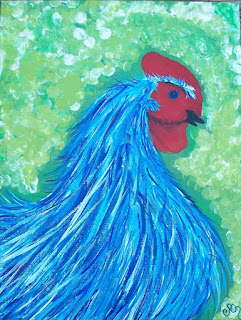 |
| Gorgeous art from Issue 3 of Six Hens |
* Note to reader: This is the "Letter from the Editor" from my literary magazine Six Hens. Issue 3 launched today. Feeling enormously proud. Read, feel something, share... *
A nurse tapped on the door before turning the handle. “I thought you’d want these,” she said as she approached me. She offered two Polaroid pictures of my newborn. Curiosity or instinct elevated my hand to receive them. “He’s beautiful. Do you have a name?” I shook my head then parted my lips to thank her. My words were reflex rather than gratitude.
She switched to nurse mode, asking when I’d last urinated or if I’d passed any clots larger than my fist and whether I wanted to breastfeed. When I said yes to that last question, she said she’d arrange for a lactation nurse to explain the basics. I didn’t protest, although I couldn’t understand how I could learn to breastfeed without a baby. Then her cool fingertips pressed my doughy abdomen. After her exam, I felt her access me in a different way. “You need to name him,” she said softly but firmly. That wasn’t any of her business. It wasn’t part of her job. But she must have heard about his x-ray, the one that showed his heart on the opposite side of his chest. She must have seen paperwork declaring “probable heart defect.” She must have known it was serious. She must have known that naming a newborn—even one with scrambled up insides—was more important than the possibility of him dying nameless.
A nurse tapped on the door before turning the handle. “I thought you’d want these,” she said as she approached me. She offered two Polaroid pictures of my newborn. Curiosity or instinct elevated my hand to receive them. “He’s beautiful. Do you have a name?” I shook my head then parted my lips to thank her. My words were reflex rather than gratitude.
She switched to nurse mode, asking when I’d last urinated or if I’d passed any clots larger than my fist and whether I wanted to breastfeed. When I said yes to that last question, she said she’d arrange for a lactation nurse to explain the basics. I didn’t protest, although I couldn’t understand how I could learn to breastfeed without a baby. Then her cool fingertips pressed my doughy abdomen. After her exam, I felt her access me in a different way. “You need to name him,” she said softly but firmly. That wasn’t any of her business. It wasn’t part of her job. But she must have heard about his x-ray, the one that showed his heart on the opposite side of his chest. She must have seen paperwork declaring “probable heart defect.” She must have known it was serious. She must have known that naming a newborn—even one with scrambled up insides—was more important than the possibility of him dying nameless.
Chalky morning light muted pinks and blues on the walls of the small room in the recovery ward of that Northern California hospital. It was before rush hour on April 3, 2003. Blankets and pillows swallowed me, but I was cold for the first time in months. My eight-pound-two-ounce furnace was in the nursery somewhere else on the floor. My fingers gripped the edges of the Polaroid pictures, which were face down on my lap. I flipped them. They were almost identical, showing a round-headed baby, eyes closed, head turned left with a breathing tube disappearing into his mouth. One image showed his torso where the umbilical cord stump had been removed. His skin was orange-red from iodine, which could’ve been mistaken for blood. I had read that a newborn’s stump normally fell off several days after birth, revealing a bellybutton. Our son, who we had yet to name, needed his cut away to use as a place to insert an IV.
I thought back to the moments after he slipped from my warm body into the cool, room-temperature air. As a hushed urgency of doctors escalated to my right, I noticed the baby was silent. “Ken? Is he breathing?” I asked my husband. He was, Ken said with his arms crossed tightly over his chest, “but something is wrong.”
A few minutes later, a nurse asked if I wanted to hold him briefly before they took him to the nursery for more tests. “I don’t think so,” I said unconvinced. After twenty hours of labor, my body was relieved to be free of him.
“You have to hold him,” Ken said. I reluctantly agreed. With my baby wrapped like a burrito in a blue, green, and white hospital blanket, the nurse set him on my chest so that I could see the creature that had been rolling around in my tummy for months. He wasn’t the most beautiful thing I had ever seen. His skin looked ashen, his face was contorted, and he was stretching his neck; it looked liked he was in pain. It felt like everyone waited for me to ooh and aah over him. But I didn’t. I just looked at him, at his twisted expression. The nurse said they had to take him. I didn’t want him any longer anyway. I felt faulty because I was not instantly in love.
When my husband returned to the recovery room, he explained that a neonatal transport team was on their way to ferry our baby to UCSF more than fifty miles south. I gave him the pictures. “You can go see him,” Ken said as he studied the photos, “if you’re ready.” When I didn’t respond, he lowered himself into the plasticky armchair to my left and took my hand. He looked thin, and dark patches underlined his pale blue eyes. It had been nearly nine hours since an initial newborn assessment forked us into separateness; I refused to accept that things were going horribly wrong. Surely he was just exhausted from being born; I was exhausted from giving birth. A few minutes later the nurse returned and parked a wheelchair next to the bed. I hesitated. Did I want to see my baby? A good mother would want to. Surely I was a good mother. Like a sack of rice, I slouched as Ken rolled me along. In a hallway carved of fluorescent light, it felt like we moved forward and backward simultaneously.
When we arrived in the nursery, I don’t remember seeing any other babies or cribs. Instead, the small space was crowded by neonatal transport experts. They prepared a special plastic box—a high-tech mobile incubator that would be placed in their ambulance. Plexiglass and a wall of EMTs separated me from my son. Through uniformed bodies, I could see bits of baby. An hand here, a knee there; so tiny, barely human under the web of intervention. He was enclosed, packaged, foreign. I wish I’d kissed his moist skin, inhaled his mossy smell when I had had the chance. The team assured us that he was stable and would be in the best of hands on his fifty-six-mile ride to UCSF, one of the top pediatric cardiac centers in the country. And then they were gone.
Kneeling in front of me as if he were about to propose, Ken’s warm hands reached for mine and pulled them to his damp face. Holding my gaze for a moment before putting his head in my lap, there was nothing to say. My fingers pushed through his trim brown hair and convulsions began. Unfamiliar sounds built in my diaphragm and erupted from my mouth, penetrating an otherwise quiet corridor. Nurses walked around us. No one asked us to move. We were left to mourn that moment. His birth. The unknown.
Eventually Ken pushed himself from the speckled linoleum and assessed my droopy posture. He brushed matted hair from my eyes. In whispers, we decided he should drive to UCSF, the hospital on a hill in our old neighborhood near Golden Gate Park, instead of waiting three more hours until I was allowed to be discharged. With that, he wheeled me back to our tiny room and helped me into bed.
“We have to name him before I leave,” he said with arms folded. I looked at his body, his denim pants and T-shirt, his waning hairline. Only in a twisted world would I debate pros and cons of naming my baby.
I hugged myself, squeezing my arms, rubbing open palms along my sides and over my vacant, shrunken stomach. “Okay,” I said after a long silence, still unsure. “Where’s the paperwork?”
He grabbed the form from the end table and clicked the end of a pen. The lines were long and blank. Without knowing his diagnosis or prognosis, I thought of the nurse, her prodding, and assumed a named child would be harder to forget than an unnamed child. He picked up the Polaroid photos and put them next to me. I studied the baby’s face and hoped it would tell me what it should be called. The blankets vibrated as my muscles shook. The stack of thin layers over my limbs didn’t seem to make a difference. After sinking down further, my eyes closed.
“We both like Riley,” he said, doing his best to keep me engaged.
My eyelids rose and focused on him. He nibbled at his cuticles as he waited for my response.
“I still like Mackenzie for a middle name,” I whispered eventually. “It means son of Ken. Then everyone knows you’re his dad. No one ever wonders who the mom is.” With that, he pushed pen to paper and our son’s name appeared. I sunk lower, clutching a pillow. He kissed my forehead, gathered his things and left.
It was incomprehensible. Riley was gone. I imagined miles of highway separating us, when nine hours earlier we had been connected. His flesh inside mine, held safe with breath and heartbeat. Nothing felt safe anymore. Ken drove home for a shower and fresh clothing before braving that unfamiliar San Francisco hospital, where he would start learning about our imperfect son, a baby I grew so horribly wrong.
It was just me in that little room. I had labored. I had delivered. But I was alone.
I didn’t know it at the time, but naming Riley despite terrifying uncertainty was a leap of faith. It was me desperately wanting him to be okay, hoping it was all a misunderstanding, a mix-up. It was also the first of many moments that define this mother’s love during my son’s truncated, eleven-year lifetime. He would have turned twelve on April 2.
Check out more powerful writing in the third issue of Six Hens!
Suzanne Galante, Editor in Chief
Monday, September 21, 2015
Grief and quiet, powerful moments
 |
| Cover art for the second issue of Six Hens. |
There are 11 ½ years of regular moments. There are 11 ½ years of milestones. On the morning of his 6th heart operation last October, when he sat next to his brother and two step siblings in the waiting room, how could I have known the last picture of them would be captured? As doctors escorted him through the double doors, his voice fell into my ears for the last time. “I love you, too,” it said.
“I don’t know what to do without you,” I say to his wardrobe, to the assorted stuffed animals, his map of the United States dotted with pushpins. “I don’t know who I am anymore. I don’t know how to be me, without you.” Waiting for a reply, I hear a skateboard roll past our house, a child shouting to a friend, laughter. I’m reminded of a day when our neighbor’s dad gave Riley a tandem ride down our hill on his skateboard. Riley beamed. That was probably one of the few moments where he felt really alive, invincible. Normal. You see, his single ventricle heart prevented him from having energy to master physical feats like skateboarding. Or the wherewithal to endure the falls that go with them.
As I stared toward the laughter, lost in memory, my husband found me sitting on Riley’s sleeping bag with a stuffed penguin in my arms. “He’s everywhere and he is nowhere,” I say. “I don’t understand. I can’t understand.” I bury my face in his cotton-filled sleeping companion, searching for my son’s scent.
“I’m not sure it will ever make sense,” he said softly, looking into this closet of neatly folded t-shirts. We scanned the room, me wanting to inhale what he had exhaled. There were puzzles and LEGO and books and posters on the walls. “These are all of his things; he’s touched all of these things.” It was only a couple of weeks earlier that I spent the weekend in his bed wearing his t-shirts, his watch, his Rainbow Loom necklace. “And look, he forgot to put his socks away,” he added, trying unsuccessfully to tether a smile to my grief.
After my husband wandered back into the house, I found myself curious about the woman in all of those photos. She’s smiling, laughing, joyful. I studied her long blonde hair. It cascades down the sides of her neck onto her chest. Through the years of photos, she’s the same. Even when a hat covers her hairline or glasses outline her eyes, her long strands follow her through the years. The baby grows into the toddler, who becomes the Little Leaguer and viola player; the long locks are consistent. Like a mother’s love, I think. Through long hospitalizations, holidays, separation and divorce, it’s there. Through new love and step-family and pets, it’s there. As his heart slowed last October and squeezed for the last time, it was there.
Four months later, it was still there. I pulled my fingers through it. It was coarse and dry from years of highlights and lowlights. I dragged a clump of neglected strands across my cheek. Frayed ends scratched dry skin. Pulling at brittle strands, pieces broke. I kissed the penguin and tucked him into the sleeping bag before heading into bathroom light.
“Who are you?” I demanded of the reflection. I stared at the her; she stared back, vertical crease between her eyes, eyebrows pinched, unrelenting furrowed brows clenched. I ran my fingers over the pinched skin trying to smooth it out, relax the angry, heartbroken muscles. There were several inches of dark growth near the scalp. “You were so happy, weren’t you? Smiling and laughing. You ignorant, stupid woman.”
Through the basket under the sink I rummaged until my hand grasped my husband’s beard trimmer. Inserting the plug into the outlet, I stared into her unblinking hazel eyes. “You don’t know anything about me.” My thumb pushed power into the clippers and vibrations ran through my arm. “Fuck you.” Blades skimmed across the ends of my hair sending clippings into the air like dust. I couldn’t go any further. For a long time, I stared her down, beaming hatred toward her, the clippers buzzing, threatening to destroy that long-haired stranger.
After a few minutes, I silenced the clippers, too chicken to shave it off. Instead, I retrieved the scissors from the kitchen knife block. Clasping a fistful of hair, I chopped through one side, then the other. Then, pulling clumps away from my scalp, I chopped those too. Again and again, I cut and sawed and chopped until any visual sign of that happy woman was gone.
Like a mound of severed limbs, a heap of hair lay on the countertop. I stared into her eyes again. Without hair to hide behind, the dark rings from exhaustion and grief stood prominently above her cheekbones. While I didn’t recognize the short-haired stranger either, she was scraggly, ugly, and looked how I felt on the inside.
Certainly my son’s death was a defining moment, the tectonic plates crashing, destroying the landscape of my life. But what has surprised me is how many defining moments have rippled in its wake. As I’m learning from talking to other grief-stricken mothers at a weekend retreat, the deaths themselves knocked our lives off course, but their aftermaths continue to mold and shape us just the same. Those smaller defining moments are equally powerful, even though they are quieter, less public, internal shifts.
Every time I see the short-haired woman, it’s a visual reminder that I am different, physically altered as well as mentally and emotionally altered by my son’s death. And I still cringe whenever someone comments on how cute my new haircut is.
The second issue of Six Hens is now live. Go read and feel something.
Suzanne Galante, Editor in Chief
Monday, June 22, 2015
Grief and Defining Moments
 |
| Introducing Six Hens |
During the last few months, grief has edged ever-so-slightly from the center to make space for creativity. It is with great honor that I introduce Six Hens, a literary magazine featuring true stories about life's defining moments. They are moments that color events in our lives, breathe life into projects, make us shift, shape, and remember. They define us; they redefine us. They are bitter, sweet, and flavor the spectrum in-between. They create the outlines that we step into. They provide the lily pads from which we leap. This magazine is me leaping...Welcome to Six Hens.
Suzanne Galante, Editor in Chief
Subscribe to:
Comments (Atom)